


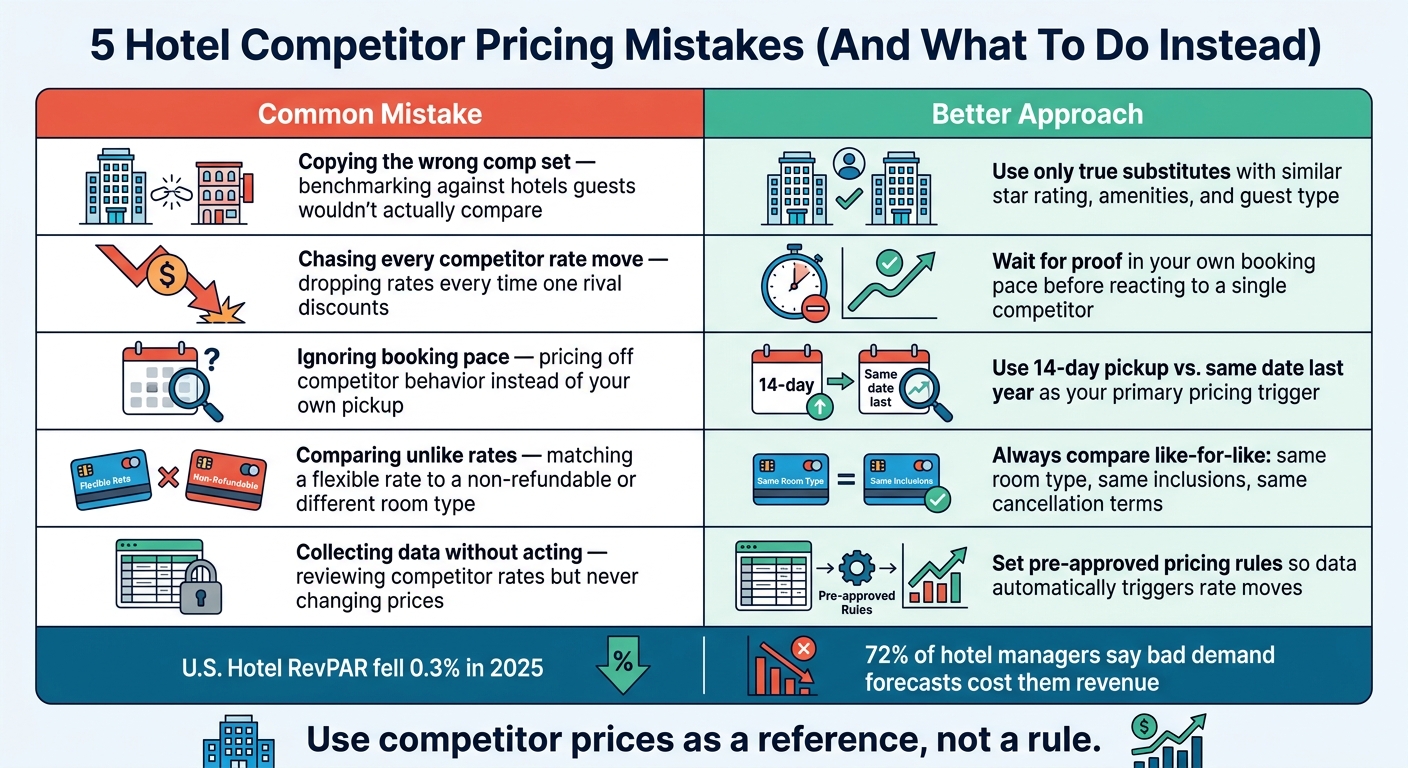
La mayoría de los errores en los precios de los hoteles se deben a un problema muy sencillo: mirar las tarifas de la competencia antes de comprobar las tuyas previsión de la propia demanda. Si tuviera que resumir la solución en una sola línea, sería esta: Usa los precios de la competencia como referencia, no como norma..
En este artículo, desgloso el tema en cinco errores comunes:
- He metido los hoteles equivocados en mi grupo de referencia
- Reacciono ante cada variación de los tipos de interés
- No me fijo en el ritmo de las reservas ni en las recogidas
- Comparo tarifas que no son comparables entre sí
- Recopilo datos de la competencia, pero no sigo unas normas claras en cuanto a los precios
Eso es más importante cuando el mercado está tan ajustado. El RevPAR de los hoteles de EE. UU. bajó 0,31 TP180T en 2025y El 72% de los directores de hotel dijo que las previsiones erróneas de la demanda les hicieron perder ingresos. Cuando los márgenes se reducen, las decisiones aleatorias sobre los precios tienen consecuencias más graves.
Aquí tienes la versión resumida:
- Elige solo sustitutos auténticos
- Comprueba la recogida antes de cambiar el precio
- No te dejes llevar por el instinto a la hora de igualar el descuento de un hotel
- Compara la oferta completa, no solo el tipo de interés que aparece en el titular
- Establece normas claras para que los datos se traduzcan en acciones
Cómo los hoteles cobran cinco veces más por la misma habitación | Te explicamos el algoritmo de fijación de precios
Comparación rápida
Error | ¿Qué es lo que falla? | Lo que debería hacer en su lugar |
|---|---|---|
Conjunto de comparables incorrecto | Sigo a hoteles que los huéspedes en realidad no compararían con el mío | Utiliza solo alternativas similares que tengan un atractivo para los huéspedes, una valoración y unos servicios parecidos |
Siguiendo cada movimiento | Bajo los precios cada vez que un competidor los baja | Esperaré a ver si se confirma a mi ritmo o si hay un cambio más generalizado en el mercado |
No tener en cuenta el ritmo | Fijo mis precios en función de lo que hacen los competidores, no de mis propias ventas | Usa el ritmo de reservas como factor principal |
Comparación de tipos de interés errónea | Comparo las tarifas según diferentes condiciones o tipos de habitación | Compara solo ofertas comparables |
Datos sin acción | Hago un seguimiento de las tarifas, pero me voy los precios no han cambiado | Crea reglas de precios sencillas, tanto diarias como semanales, o utiliza precios dinámicos en los hoteles para automatizar el proceso |
Si tengo en cuenta esos cinco puntos, la política de precios de la competencia se vuelve mucho menos reactiva y mucho más coherente.
Por qué los precios de la competencia necesitan normas, y no conjeturas
Un conjunto de referencia es el grupo de hoteles que un huésped reservaría realmente en lugar del tuyo. Si ese conjunto de referencia no es el adecuado, todas las reglas de precios basadas en él tampoco lo serán.
Esa es la primera trampa. Los hoteles suelen fijarse en las tarifas de los alrededores y las toman como una referencia. Pero las tarifas de la competencia solo muestran lo que otro property ha decidido cobrar. Lo que hacen no mostrar por qué si ese precio se fijó así, o si fue siquiera la decisión correcta. Un hotel que está casi completo puede mantener su tarifa sin cambios incluso cuando hay un hotel cercano más barato [3]. La tasa por sí sola no te cuenta toda la historia.
Aquí es donde la gente se lía. El anuncio de la competencia no menciona lo que realmente influye en las decisiones sobre los precios: el ritmo de reservas, la composición de las habitaciones y restricciones de estancia[1][3]. Esas señales suelen decirte mucho más que el número que aparece en la pantalla.
Tu objetivo no es igualar a todos los hoteles de la zona. Se trata de mantener la posición adecuada en el mercado basándote en tu propia demanda. El conceptos básicos de la gestión de ingresos Deja eso claro. Si vendes 40 habitaciones a $120, obtienes $4.800. Si vendes 50 habitaciones a $80, obtienes $4.000 [3]. El RevPAR es más importante que la simple ocupación [3][5].
Así que el orden es importante. Empieza con unas tarifas basadas en tu propia demanda y, después, usa las tarifas de la competencia como referencia, no como factor determinante.
El primer error es elegir los hoteles equivocados a los que seguir.
1. Incluir hoteles equivocados en tu grupo de referencia
El primer error es elegir hoteles que no sean sustitutos reales. Tu grupo de referencia debería incluir solo sustitutos directos.
Un error muy común es comparar tu hotel con otros que atraen a un tipo de huésped diferente. Un hotel económico no debería compararse con uno de servicio completo que tenga piscina y spa. El perfil de los huéspedes es distinto, la oferta es diferente y la gente no suele comparar esos hoteles entre sí. Tu grupo de referencia debería basarse en hoteles con servicios, valoración y atractivo para los huéspedes similares. En el caso de los hoteles de destino, en forma es más importante que la distancia. En cuanto ese ajuste falla, las comparativas de tarifas empiezan a llevarte por el camino equivocado.
Una señal de alerta clara es cuando bajas los precios por un problema de la competencia, y no porque te lo pida tu propia clientela. Si un hotel cercano baja mucho las tarifas tras una cancelación de un grupo y tú haces lo mismo sin pensarlo, estás regalando ingresos sin motivo alguno [1].
Curso de revenue management analiza tu ritmo de reservas y la demanda local en tiempo real para ajustar las tarifas automáticamente, para que los movimientos aleatorios de la competencia no acaben condicionando tus precios. La solución es bastante sencilla: define el grupo de referencia una vez y, después, deja que tu propio ritmo y la demanda marquen la tarifa.
2. Ir detrás de cada cambio en las tarifas de la competencia
Aunque hayas elegido el conjunto de referencia adecuado, te espera otra trampa: reaccionar ante cada uno de los cambios en las tarifas.
Esta es una de las formas más rápidas de hacer bajar el ADR. A primera vista, puede parecer una medida disciplinada. Ves que un competidor baja sus tarifas y tú respondes. Sencillo, ¿verdad? El problema es que bajar el precio no genera automáticamente más demanda. Muchas veces, solo significa que ganas menos en habitaciones que, de todas formas, se iban a vender.
Un ejemplo habitual es fijar el precio de tus habitaciones Del $5 al $10 que aparecen a continuación un competidor al día, independientemente de cómo vaya tu ritmo de reservas [2][3]. Ese tipo de medida puede salirte por la culata en un santiamén. Si ya casi has agotado las plazas, igualar el descuento de un competidor solo significa que estás regalando ingresos por habitaciones que probablemente se habrían reservado incluso sin ese descuento [1][2]. No estás consiguiendo clientes nuevos. Solo estás reduciendo lo que ganas con la demanda que ya tenías.
Lo mejor es usar las bajadas de precios de la competencia como una señal, no como una orden automática. Si tu propio ritmo de ventas empieza a ralentizarse, entonces puede que tenga sentido reaccionar. Pero si las ventas van al mismo ritmo o por delante de las del año pasado, normalmente no hay razón para seguir a la competencia a la baja [1][2].
Esto es importante porque la bajada de las tarifas de un hotel suele reflejar un problema específico de property, no un cambio en todo el mercado [1][5]. Quizás tengan una actividad del grupo más moderada. Quizás estén intentando cubrir una vacante en un tipo de habitación concreto. Quizás hayan tomado una mala decisión. Sea cual sea la razón, el descuento de un vecino sí que no eso siempre significa que la demanda está bajando para todo el mundo.
Una señal real del mercado se ve de otra manera. Lo normal es que veas varios competidores que evolucionan en la misma dirección al mismo tiempo, lo que apunta a un cambio más amplio en la demanda local. Te cuento que...
Curso de revenue management Lo gestiona filtrando los movimientos de la competencia en función de tu ocupación y tu ritmo de reservas antes de cambiar las tarifas. Así que, si un property cercano baja el precio por su cuenta, eso por sí solo no activa tarificación automatizada cambios en tu hotel. Te informo de...
El siguiente paso es comparar solo las tarifas que realmente se ajustan a tu inventario.
3. No tener en cuenta el ritmo de reservas y la recogida
Una vez que tengas tu grupo de referencia definido, el ritmo de reservas debería ser lo que te guíe a la hora de decidir si das un paso adelante. Las tarifas de la competencia muestran lo que ofrecen otros hoteles pienso el mercado lo pagará. El ritmo de reservas te muestra lo que está pasando ahora mismo en tu property. Si te saltas esa comprobación, acabas fijando los precios en función de las condiciones de otra persona en lugar de las tuyas propias.
Este es el error en el que cae mucha gente: tu hotel se está llenando más rápido que en la misma época del año pasado, pero aun así bajas las tarifas porque un competidor lo ha hecho. Eso significa que estás haciendo descuentos en las habitaciones aunque la demanda ya se estuviera notando. Si sigues los pasos de la competencia sin fijarte en tu propio ritmo, es muy fácil dejar de ganar dinero.
Una forma sencilla de analizarlo es revisar el ritmo cada semana y comparar el aumento de los últimos 14 días con el de la misma fecha del año pasado. Si vas muy por delante, eso suele ser una señal de que debes mantener las tarifas estables o subirlos un poco, en lugar de copiar el descuento de un competidor. Venderlo todo demasiado pronto a menudo indica que los precios son demasiado bajos, y te deja menos margen para aceptar reservas de última hora con mejores valoraciones [2].
Hay que analizar con más detenimiento esta ralentización. A veces, los huéspedes simplemente reservan más tarde de lo que solían hacerlo. Así que, antes de bajar las tarifas, asegúrate de que la ralentización es real.
Curso de revenue management registra el ritmo y el aumento de la demanda a lo largo del día y, luego, ajusta las tarifas por sí solo cuando la demanda empieza a crecer más rápido de lo esperado.
El siguiente error es comparar tipos de habitaciones y tarifas que no son comparables.
4. Comparar tipos de habitaciones y productos tarifarios diferentes
Este error empieza cuando los hoteles comparan tarifas que no son lo mismo. Y si las condiciones del producto no coinciden, la comparación no te sirve de mucho.
Una tarifa que parece más baja puede ocultar distintas restricciones, condiciones o elementos incluidos. Si bajas tu propio precio para igualarlo, puedes acabar fijando un precio poco acertado [3]. Esto suele pasar cuando un hotel compara una habitación estándar con otro tipo de habitación, o una tarifa flexible con una no reembolsable.
La solución es sencilla: comparar lo que es comparable.
- Combina tu tarifa flexible con otra tarifa flexible
- Elige el tipo de habitación que más se acerque al equivalente
- Gestiona los distintos tipos de habitaciones y restricciones con diferentes estrategias de precios
Precio solo frente a sustitutos reales. Si la oferta de la competencia es solo un sustituto poco convincente, úsala como indicio, no como objetivo directo para fijar tus precios.
Aquí es donde la automatización puede ayudar. Cuando las reglas se aplican a mano, se cuelan errores. Curso de revenue management utiliza el contexto de las tarifas y una lógica de precios clara para evitar comparaciones erróneas. te informa.
Una vez que se han emparejado bien los productos de tarifas, surge otro problema: recopilar los datos y luego no hacer nada con ellos.
El último error es considerar los datos de la competencia como información para informes en lugar de como una regla de fijación de precios.
5. Recopilar datos de la competencia sin hacer nada al respecto
Muchos hoteles comprueban a diario las tarifas de la competencia, pero luego no hacen nada con esa información. El equipo revisa las cifras, quizá las comenta, pero las tarifas de las habitaciones siguen siendo las mismas. Eso no es una estrategia de gestión de ingresos. Solo es una noticia.
La cuestión fundamental es sencilla: los datos sin una regla no impulsan la acción. Si no hay un criterio claro que indique cuándo hay que ajustar las tarifas, los datos de la competencia se quedan ahí, en una hoja de cálculo, en lugar de influir en la fijación de precios.
Así es como funciona en la práctica: si las recogidas van mucho mejor que el año pasado, las tarifas deberían subir aunque la competencia se mantenga estable. Esa es la clave. Los datos solo importan cuando llevan a un cambio en las tarifas. Y ese cambio tiene que ser lo suficientemente rápido como para adaptarse a los cambios en la demanda antes de que se acabe el plazo.
La gestión del tiempo es donde muchos hoteles se atascan. Curso de revenue management Aplica esas reglas automáticamente, basándose en el ritmo de reservas en tiempo real y en la posición de la competencia, para que no se te escape ningún cambio en la demanda. Una vez configurada esa regla, los hoteles pueden convertir el seguimiento de la competencia en un proceso semanal de fijación de precios.
En la siguiente sección, los datos de la competencia se convierten en reglas de fijación de precios que los hoteles pueden aplicar esta misma semana.
Reglas de precios que los hoteles pueden poner en práctica esta semana
Convierte esas señales en un breve conjunto de reglas que tu equipo pueda usar a diario. El objetivo es sencillo: establecer unos cuantos criterios predefinidos para las revisiones diarias de las tarifas, para que la gente no tenga que ir a ciegas. Cada una de las reglas que aparecen a continuación te ayuda a corregir uno de los cinco errores de fijación de precios que hemos comentado antes.
- Compara solo los sustitutos reales. Comparar directamente las tarifas solo tiene sentido cuando estás buscando alojamientos que sean realmente similares. Si otro hotel tiene servicios diferentes, toma su precio como una indicación, no como un objetivo [2].
- No te dejes llevar por los movimientos de precios de un solo competidor. Primero, averigua por qué El precio ha cambiado. Es posible que la tarifa más baja se deba a una cancelación de grupo de última hora, y no a un problema de demanda del mercado que también afecte a tu hotel. [1].
- Utiliza el ritmo de reservas como factor principal. Si la recogida va 10% por delante respecto al año pasado, sube el BAR poco a poco [4].
- Utiliza normas sobre la duración mínima de la estancia (MLOS) en las noches de mayor afluencia. En lugar de limitarte a subir el BAR al máximo, usa las restricciones de MLOS para conseguir estancias más largas y proteger las noches de menor ocupación. [1][3].
- Comprueba siempre que las condiciones sean las mismas antes de aceptar una tarifa más baja. Puede que la tarifa que anuncia la competencia no sea reembolsable, no incluya el desayuno o exija una estancia mínima. No es el mismo producto, así que no deberías igualarla sin analizarla más a fondo.
Usa la tabla de abajo para comprobar si una tarifa más baja es realmente comparable.
Factor de comparación | Qué hay que comprobar | Repercusión en el precio |
|---|---|---|
Valora el producto | BAR frente a no reembolsable | Los billetes no reembolsables suelen costar entre 10% y 20% menos [2] |
Incluye | Desayuno, aparcamiento, wifi | Las ventajas incluidas pueden justificar una prima de $15 a $30 [2] |
Tipo de habitación | Habitación estándar frente a suite | Comparar habitaciones que no son iguales hace que el precio sea demasiado bajo [2] |
Restricciones de estancia | Duración mínima de la estancia (MLOS) | Las tarifas de MLOS suelen ser más bajas para impulsar el volumen [1][3] |
Curso de revenue management Aplica estas reglas automáticamente basándose en los datos de tu reserva, la demanda en tiempo real y las tarifas de la competencia.
Usa las tablas comparativas que aparecen a continuación para comprobar cada tarifa antes de cambiarla.
Tablas comparativas para tomar mejores decisiones sobre precios
Usa estas tablas como una revisión diaria rápida. Se vuelven anchas estrategias de precios hoteleros para que puedas echarle un vistazo en un minuto y pasar a la acción.
¿Tu grupo de referencia es realmente comparable?
| Factor | El rival ideal | Un competidor que no da la talla |
|---|---|---|
| Distancia | En un radio de 2 millas o en el mismo submercado | A más de 5 millas de distancia o en otro barrio |
| Valoración por estrellas | Igual (p. ej., 3 estrellas frente a 3 estrellas) | Diferentes (por ejemplo, de 2 estrellas frente a 4 estrellas) |
| Tipo de huésped | Lo mismo (p. ej., corporativo/empresarial) | Otros (p. ej., familia/ocio) |
| Servicios destacados | Son parecidos (por ejemplo, los dos tienen piscina y gimnasio) | No coincidentes (p. ej., con spa frente a sin spa) |
| Valoración de los usuarios | Comparables (p. ej., 4,2 frente a 4,4) | Gran diferencia (por ejemplo, 2,5 frente a 4,8) |
Si el conjunto de referencia no es el adecuado, la señal de precios tampoco lo es. Un hotel que está a cinco millas de distancia, en otro barrio, puede parecer un competidor sobre el papel, pero puede dirigirse a un tipo de cliente y tener un patrón de demanda totalmente diferentes.
Una vez que el conjunto de competidores esté bien definido, el siguiente paso es sencillo: ¿El modelo coincide con tu furgoneta? ¿Te queda bien?
| Situación | Mal paso | Más vale que te vayas |
|---|---|---|
| Las ventas de camionetas han subido 20% respecto al año pasado | Mantén las tarifas iguales a las de la competencia | Subir las tarifas para atraer a los clientes de gama alta |
| Un competidor baja la tarifa en $20 | Reacciona al instante | Mantén la tasa de retención si tu ocupación va según lo previsto |
| La recogida se retrasa 10 días | Descuento de pánico con una rebaja importante | Aplica una regla de plazo de entrega (por ejemplo, 10% desactivada) |
| Se ha añadido un evento local importante al calendario | Espera a ver qué hacen los demás | Aumenta las tarifas de forma proactiva en función de la demanda |
Este nivel de capacidad de respuesta suele ser más fácil cuando tú automatiza los precios de tu hotel para registrar los turnos en tiempo real.
Aquí es donde muchos equipos cometen errores. Ven que un rival baja a $20,00 y reaccionan por instinto. Pero si tu ocupación está donde debe estar, igualar ese recorte puede hacer que pierdas cuota de mercado sin motivo alguno.
Antes de aceptar cualquier tipo de interés más bajo, compara el oferta completa, no solo el precio que aparece a simple vista. Eso significa el tipo de habitación, lo que incluye y cualquier restricción de reserva. Un precio más barato puede dejar de parecerlo una vez que tienes en cuenta el desayuno, el wifi o las condiciones de reembolso.
| Detalles de la habitación | Tu hotel (estándar) | Competidor A (Estándar) | Competidor B (Estándar) |
|---|---|---|---|
| Tipo de interés nominal | $150.00 | $145.00 | $180.00 |
| Inclusiones (Valor) | Desayuno y wifi (+$25) | Solo WiFi (+$5) | Pensión completa (+$60) |
| estancia mínima | Flexible (24 h) | No reembolsable | Cancelación con 7 días de antelación |
| Valor tras las inclusiones | $125 | $140 | $120 |
Esa última fila es la que cuenta. A primera vista, el competidor A parece más barato que tu tarifa de $150,00. Pero una vez que tienes en cuenta lo que incluye, tu oferta resulta más ventajosa. El competidor B parece caro a primera vista, pero su oferta con pensión completa cambia las cuentas.
Utiliza valor efectivo, y no el tipo de interés oficial, a la hora de decidir si te mudas. Así, los datos de la competencia siguen siendo útiles y no se convierten en una reacción exagerada diaria.
Conclusión final
Tras analizar las comparaciones, la conclusión es sencilla: los precios de la competencia funcionan solo cuando las normas marcan la decisión, y no con reacciones impulsivas. La mayoría de los errores en la fijación de precios tienen su origen en lo mismo: usar los datos de la competencia antes de comprobar tu propio ritmo de reservas y la demanda local.
La rutina diaria está bastante clara:
- Crea un conjunto de comparativa compuesto por sustitutos reales
- Comprueba la tarifa de recogida antes de mudarte
- Compara ofertas equivalentes
- Tasa de retención cuando la demanda es alta
Esa es la disciplina de precios que los hoteles necesitan cada día.
Curso de revenue management automatiza la fijación diaria de precios utilizando los datos de reservas de cada property y la demanda local en tiempo real, sin dejar de permitir la revisión manual. Así resulta más fácil aplicar las mismas reglas a más fechas y tipos de habitaciones.
A la hora de fijar los precios, las reglas son mejores que las conjeturas.
Preguntas frecuentes
¿Con qué frecuencia debería revisar mi grupo de referencia?
Revisa y ajusta tu grupo de referencia trimestral así que sigue reflejando el mercado a medida que cambian las condiciones. te informo de que….
Al mismo tiempo, no pierdas de vista los cambios en las tarifas de la competencia diario en los próximos 30 a 60 días. Así tendrás una idea clara de cuál es tu posición en el mercado. Una herramienta automatizada como Curso de revenue management puede hacer un seguimiento de esos cambios por ti, así que no tendrás que hacer comprobaciones manuales a diario.
¿Qué indicadores del ritmo de reservas deberían dar lugar a un cambio en las tarifas?
El ritmo de reservas muestra la rapidez con la que se están recibiendo reservas para futuras fechas de estancia, en comparación con las tendencias anteriores o tus objetivos de demanda. Cuando ese ritmo se sitúa muy por encima o por debajo de esos valores de referencia, suele tener sentido ajustar las tarifas.
Si el ritmo se acelera, por ejemplo, 30% por delante lo mismo que el año pasado: sube los precios. Si las reservas se están ralentizando o no alcanzan tu objetivo, baja los precios para impulsar la demanda.
¿Cómo puedo comparar de forma imparcial las tarifas de la competencia?
No te limites a igualar los precios. Las tarifas de la competencia deben servirte de guía a la hora de fijar tus precios, no dictarlos. Así es como evitas una carrera hacia abajo y pierdes menos beneficios.
Elige un conjunto concreto de de cinco a diez propiedades similares. Luego compara en términos comparables tipos de habitaciones, servicios incluidos y restricciones. A partir de ahí, compáralo con tu propio ritmo de reservas, la ocupación y los resultados anteriores.