



Hotels zouden hun prijzen moeten baseren op boekingspatronen, niet op giswerk.
Als ik kijk naar wanneer gastenboek, welke dagen wat ze willen, waar ze boeken, en of Als ze terugkomen, kan ik tarieven vaststellen die bescherming bieden bezettingsgraad, ADR, RevPAR en netto-omzet.
Hier volgt de korte versie:
- Levertijd draagt bij aan het vaststellen van tariefschijven, van dezelfde dag tot meer dan 90 dagen van tevoren
- Dag van de week geeft aan waar de weekdag- of weekendtoeslagen thuishoren
- Duur van het verblijf helpt bepalen wanneer regels inzake een minimumverblijf zinvol zijn
- Kanaalmix is van belang omdat een kamer die rechtstreeks wordt verkocht vaak meer opbrengt dan een kamer die via een OTA wordt verkocht, waardoor Prijzen bij OTA’s versus rechtstreekse boekingen een belangrijke factor voor de winstgevendheid
- Annuleringskosten kan de werkelijke waarde van een boeking wijzigen
- Terugkerende gasten reageren vaak beter op extraatjes dan op algemene kortingen
- Automatisering helpt deze regels dagelijks toe te passen in plaats van handmatig
Een paar cijfers maken het duidelijk:
- OTA-commissies lopen vaak 15%–30%
- De kosten bij rechtstreekse boekingen zijn vaak 3%–7%
- De annuleringspercentages bij OTA’s kunnen oplopen tot 30%–50%
- De tarieven voor directe annulering zijn vaak 10%–25%
- Op de hierboven genoemde piekdata 80% verwachte bezettingsgraad, kunnen hotels hun prijzen vaststellen 30%–50% nachten boven de schouder
Het basisidee is dus simpel: Vraag niet alleen: “Welk tarief kan ik hanteren?” Vraag: “Welke boeking levert na aftrek van kosten, annuleringen en de uitgaven van de gasten het meeste op?” Die verschuiving leidt tot betere prijsbeslissingen, minder ondoelmatige kortingen en meer controle over de marge.
Hieronder zal ik de belangrijkste boekingssignalen bespreken die hotels gebruiken, en uitleggen hoe elk daarvan verband houdt met een prijsbeslissing.
Stel prijsregels op basis van de doorlooptijd en de verblijfsdata op
Boekingsperiodes indelen in doorlooptijdcategorieën
De doorlooptijd is vaak het eerste reserveringspatroon waarop een hotel zijn prijzen moet afstemmen. Begin met 12 tot 24 maanden aan reserveringsgegevens uit uw PMS of channelmanager. Bereken voor elke reservering de doorlooptijd als het aantal dagen tussen de reserveringsdatum en de incheckdatum. Sorteer de reserveringen vervolgens in bruikbare categorieën: dezelfde dag, 1–3 dagen, 4–7 dagen, 8–14 dagen, 15–30 dagen, 31–90 dagen en meer dan 90 dagen.
Bekijk voor elke categorie de gemiddelde dagopbrengst (ADR), het annuleringspercentage, de verblijfsduur en de kanaalsamenstelling. Zo kun je op een eenvoudige manier bepalen waar je een toeslag moet toepassen, waar je de basistarieven ongewijzigd moet laten en waar een korting alleen zinvol is tijdens rustige periodes.
Er is één patroon dat de moeite waard is om goed in de gaten te houden: de ADR voor boekingen op dezelfde dag is niet altijd lager. In drukkere periodes kan deze gelijk zijn aan of zelfs hoger liggen dan je totale ADR. Uit een onderzoek bleek dat het gemiddelde voor weekendboekingen op dezelfde dag $121.20 tegenover een gemiddelde dagprijs (ADR) voor het hele weekend van $117.20, en in het hoogseizoen bedroeg de ADR voor boekingen op dezelfde dag $147.60 in vergelijking met een algemeen $144.50.[1] Dus als je eerste neiging is om op het laatste moment de prijs drastisch te verlagen, doe dan even rustig aan.
Gebruik dit raamwerk:
| Doorlooptijdband | De typische gast | Prijsgevoeligheid | Aanbevolen prijsmaatregel |
|---|---|---|---|
| Dezelfde dag nog | Zonder reservering / last-minute reizigers | Laag wanneer de vraag groot is; hoog wanneer de vraag gering is | Houd vast aan de prijs of breng op dagen met grote vraag een toeslag voor boekingen op dezelfde dag in rekening; geef alleen korting als de bezettingsgraad duidelijk achterblijft bij de doelstelling |
| 1–3 dagen | Op korte termijn / spontaan | Variabele | Houd de tarieven stabiel als er weinig kamers beschikbaar zijn; pas slechts bescheiden kortingen toe als de vraag zwak is |
| 4–7 dagen | Vrijetijdsactiviteiten op korte termijn | Hoog | Pas een kleine korting of een extra voordeel alleen toe wanneer de bezettingsgraad aanzienlijk achterblijft bij het verwachte tempo |
| 8–14 dagen | Planners met een korte planningperiode | Matig | Houd het tempo in de gaten ten opzichte van de verwachtingen en voer alleen kleine neerwaartse bewegingen uit als het momentum zwak is |
| 15–30 dagen | Standaard vrijetijds-/zakenreis | Matig | Houd de tarieven dicht bij het basisniveau en gebruik dit als referentiekader |
| 31–90 dagen | Vroege planners | Laag tot matig | Houd de tarieven dicht bij het basisniveau, of voeg een kleine toeslag toe als het boekingstempo hoger ligt dan in het verleden |
| meer dan 90 dagen | De allereerste planners | Laag | Overweeg een bescheiden vroegboekkorting als de vraag groot is en het tempo hoger ligt dan in het verleden |
Het doel is simpel: het tarief van elke band afstemmen op het vraagssignaal. Zodra je de tarieven voor de boekingsperiodes hebt vastgesteld, kun je daar regels voor de dag van de week en de verblijfsduur aan toevoegen.
Tarieven instellen op basis van de dag van de week en de verblijfsduur
Nadat u de doorlooptijdcategorieën in kaart hebt gebracht, bekijkt u de prestaties per dag van de week. Bekijk elke dag van de afgelopen 6 tot 12 maanden en verdeel de gegevens indien mogelijk per seizoen. Richt je op de bezettingsgraad, de gemiddelde kamerprijs (ADR), de gemiddelde verblijfsduur en het belangrijkste segment of kanaal. In markten waar zakelijke reizen de boventoon voeren, is de vraag doordeweeks doorgaans het grootst en neemt deze in het weekend af. In vrijetijdsmarkten zijn vrijdag en zaterdag meestal het drukst. Een vast weektarief houdt geen rekening met dat patroon.
De verblijfsduur is net zo belangrijk. Als uit je gegevens blijkt dat de kamers op vrijdag en zaterdag snel vol raken, maar dat het meestal om korte verblijven gaat, dan is een regel inzake de minimumverblijfsduur op die data kan helpen de inkomsten veilig te stellen. Aan de andere kant, als er doordeweeks al vanzelf langere zakelijke verblijven worden geboekt, heeft een strikte regel voor een minimumverblijf wellicht weinig nut, behalve dan dat het goede boekingen in de weg staat.
Gebruik dit raamwerk:
| Dag van de week | Gemiddelde bezettingsgraad | ADR-positie | Dominant segment | Aanbevolen tariefpositie |
|---|---|---|---|---|
| Maandag–donderdag | Hoger op de zakelijke markten; lager op de vrijetijdsmarkten | Premium op de zakelijke markten | Bedrijven / zakelijk | Hanteer op doordeweekse dagen een hoger tarief in markten met veel zakelijk verkeer; hanteer op doordeweekse dagen lagere tarieven in recreatieve markten |
| Vrijdag–zaterdag | Hoger in de vrijetijdsmarkten; lager in de zakelijke markten | Premium op de vrijetijdsmarkten | Vrije tijd / weekend | Prijzen liggen in het weekend hoger in de vrijetijdsmarkten; zakenhotels kunnen terugvallen op lagere weekendtarieven of arrangementen |
| zondag | Meestal het laagst | Met korting / schouder | Gemengd / vrijetijdsbesteding | Maak indien nodig gebruik van een ‘shoulder-night’-korting om het verblijf te verlengen |
Op drukke dagen, zodra de verwachte bezettingsgraad 80%, verandert de taak. Je bent niet langer bezig met het vullen van kamers. Je probeert de gemiddelde dagprijs (ADR) te verhogen. In die fase zijn premies van 30% tot en met 50% Basisprijzen voor overnachtingen met overnachting kunnen zinvol zijn.[2] Het is ook handig om deze regels elk kwartaal nog eens door te nemen, omdat de samenstelling van de segmenten in de loop van de tijd verandert en je drukste avonden niet altijd hetzelfde blijven.
Zodra de op datums gebaseerde regels zijn ingevoerd, moet u deze per kanaal vergelijken om de netto-omzet te beschermen. De implementatie van deze strategieën kan leiden tot aanzienlijke resultaten op het gebied van inkomstenbeheer voor zelfstandige woningen.
Maak gebruik van een mix van zenders en herhaal gastpatronen om de netto-omzet veilig te stellen
Vergelijk de prestaties van directe boekingen, OTA’s en zakelijke kanalen
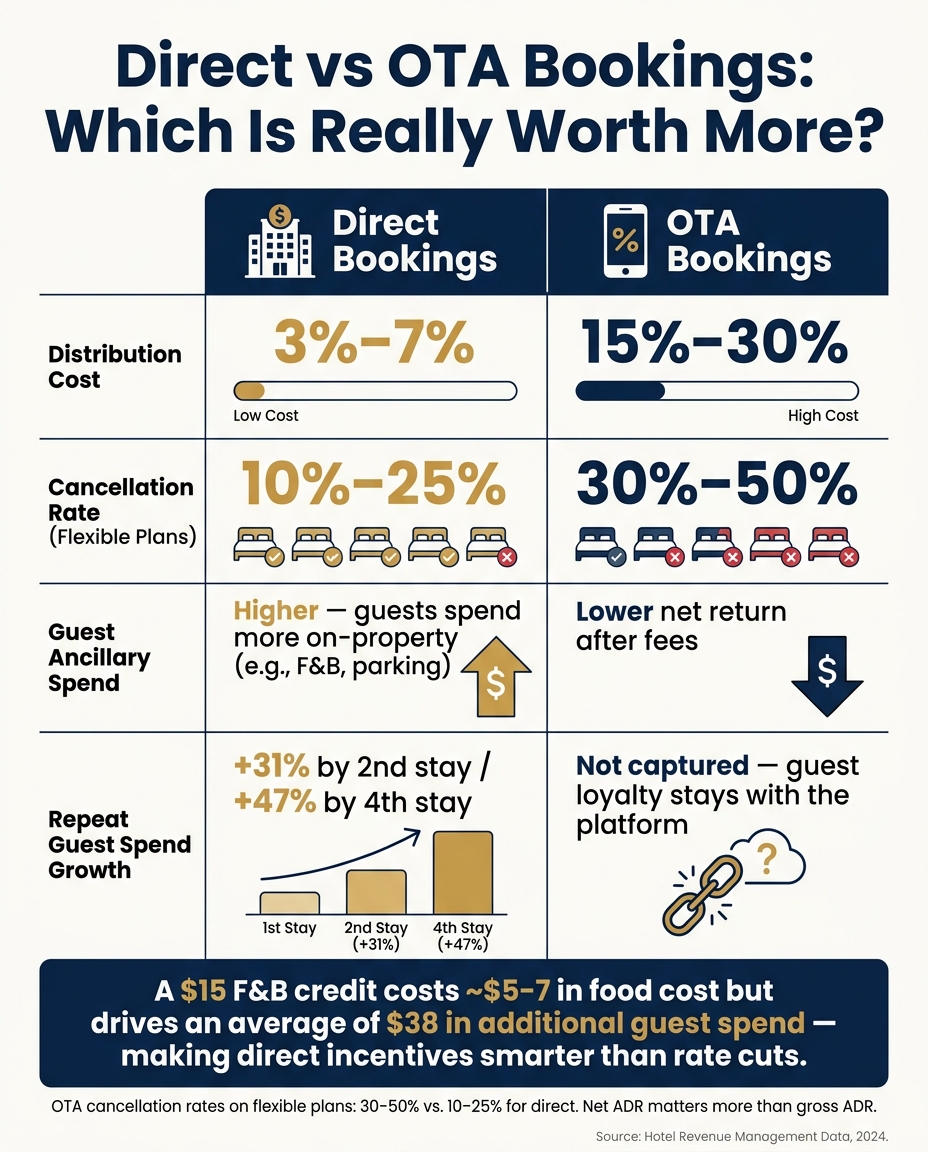
Hetzelfde nominale tarief kan leiden tot zeer uiteenlopende netto-inkomsten, afhankelijk van waar de boeking vandaan komt. Online reisbureaus (OTA’s) nemen vaak 15%–30% in commissie, terwijl de kosten voor rechtstreekse boekingen doorgaans 3%–7%.
Er is nog een ander probleem: bij OTA-boekingen is het annuleringspercentage vaak hoger. Bij flexibele boekingen worden annuleringen doorgaans 30–50% voor online reisbureaus, in vergelijking met 10–25% voor rechtstreekse boekingen. [6][7][8][9][10] Als je alleen naar de bruto ADR kijkt, loop je al snel het risico om omzet na te jagen die uiteindelijk niet volledig tot uiting komt.
Een betere manier is om elk kanaal te beoordelen vanuit het perspectief van de netto-omzet. Dat betekent dat je kijkt naar ADR, netto-ADR na aftrek van distributiekosten, annuleringspercentage, doorlooptijd en totale besteding per gast. Reken daarna ook rekening met mogelijke neveninkomsten, zoals ontbijt, parkeren of eten en drinken. Soms blijkt de boeking met het lagere openbare tarief toch de betere keuze te zijn als je het volledige plaatje in ogenschouw neemt.
| Kanaal | Typische commissie | Annuleringspercentage | Waarde-signaal | Aanbevolen aanpak |
|---|---|---|---|---|
| Direct | 3–7% [6][7][8] | 10–25% [7][9][10] | Hogere uitgaven aan bijkomende kosten [4] | Maak gebruik van extra voordelen zoals ontbijt, parkeergelegenheid of flexibele voorwaarden om de vraag naar directe boekingen te stimuleren |
| OTA | 15–30% [7][8][10] | 30–50% [7][9][10] | Lager nettorendement na aftrek van kosten | Zorg ervoor dat de openbare tarieven op peil blijven en gebruik dit kanaal om de minder drukke data te vullen |
| Bedrijven | Onderhandeld/gematigd | Matig | Voorspelbare vraag halverwege de week | Maak gebruik van segmentgebaseerde prijsstelling en flexibele voorwaarden in plaats van de tarieven te verlagen |
In de praktijk betekent dat meestal dat de publieke tarieven op dure kanalen stabiel worden gehouden en dat er gebruik wordt gemaakt van strategische beslissingen over hotelprijzen zoals stimulansen voor rechtstreekse boekingen in plaats van algemene kortingen. Een gratis parkeerplaats of flexibele annuleringsvoorwaarden bij rechtstreekse boekingen kunnen al voldoende zijn om een gast over te halen, zonder dat je je openbare tarief hoeft aan te passen.
Dezelfde benadering op basis van netto-omzet geldt ook voor terugkerende gasten.
Prijs voor terugkerende gasten zonder dat dit ten koste gaat van de marge
Terugkerende gasten vormen een apart segment, en het is verstandig om de prijs af te stemmen op de waarde, niet op de status.
Uit een dataset bleek dat de bijkomende uitgaven waren gestegen 31% bij de tweede steun en 47% bij de vierde steun. [3] Daarom kunnen algemene loyaliteitskortingen averechts werken. Ze zorgen ervoor dat gasten elke keer een lager tarief gaan verwachten, waardoor de marge beetje bij beetje afneemt.
Een betere aanpak is om terugkerende gasten met een hoge waarde te herkennen aan de hand van praktische signalen zoals boekingsfrequentie, voorkeur voor kamertype, annuleringsgeschiedenis, verblijfsfrequentie en totale verblijfswaarde. Beloon ze daarna met beperkte kortingen of extra voordelen In plaats daarvan. Een tarief exclusief voor leden dat gekoppeld is aan een rechtstreekse boeking, een gratis ontbijt of laat uitchecken, kost vaak minder dan een rechtstreekse tariefverlaging en is voor gasten veel moeilijker te vergelijken tussen de verschillende boekingskanalen.
Hier is een eenvoudig voorbeeld. Een $15 studiepunten voor eten en drinken kost ongeveer $5–7 aan voedselkosten, maar gasten die er gebruik van maken, geven gemiddeld $38: meer dan alleen studiepunten. [5] Dat maakt het een slim instrument om gasten te binden. Je stimuleert loyaliteit, houdt de gast betrokken bij property en voorkomt dat je zichtbare kamerprijs onder druk komt te staan.
Controleer, voordat je de prijs verlaagt, de boekingsfrequentie, de annuleringsgeschiedenis, de frequentie van de verblijven en de totale uitgaven.
Pas automatisering toe op de hele agenda en het hele portfolio
Hoe geautomatiseerde prijsbepaling dagelijks gebruikmaakt van gedragsgegevens
Zodra je die op gedrag gebaseerde regels hebt ingesteld, zorgt de automatisering ervoor dat ze voor elke toekomstige datum op de kalender worden toegepast. Dat is belangrijk, omdat handmatige prijsbepaling de dagelijkse schommelingen in de vraag simpelweg niet kan bijhouden. Optimaliseer je prijzen in real-time past de tarieven de hele dag door aan naarmate de vraag verandert.
Het systeem analyseert historische boekingspatronen, de huidige bezettingsgraad en actuele vraagsignalen, en past vervolgens de toekomstige tarieven gedurende de dag aan. Naarmate het aantal boekingen, de bezettingsgraad en de vraagsignalen veranderen, blijft dezelfde prijsbepalingslogica op de achtergrond werken.
Het past ook zelfstandig je basistarief, tempo en doorlooptijdregels toe. Stel dat een zaterdag over 30 dagen qua boekingen voorloopt op de gebruikelijke bezettingsgraad. In dat geval kan het systeem de tarieven ongewijzigd laten of verhogen. Als een doordeweekse datum achterblijft op de doelstelling, kan het de prijzen verlagen om de vraag te stimuleren.
Minimale en maximale tarieven fungeren als vangrails voor die veranderingen. Het systeem kan de prijzen binnen dat bereik aanpassen, maar zal niet onder uw minimumtarief komen of boven uw maximumtarief uitkomen. Dit helpt bij het beschermen van de marge, de merkperceptie en de onderhandelde tariefstructuren.
Waar RoomPriceGenie geschikt is voor onafhankelijke hotels en hotelketens
Voor hotels die deze regels automatisch willen laten afhandelen, RoomPriceGenie zorgt voor de dagelijkse tariefupdates. RoomPriceGenie is vanaf de basis ontwikkeld voor onafhankelijke hotels, B&B’s, serviceappartementen, eigenaars-exploitanten en hotelgroepen. Het is niet afgeleid van een bedrijfssysteem.
Het platform maakt gebruik van de eigen boekingsgegevens van elke property en de actuele lokale vraag om de tarieven automatisch vast te stellen. Volgens het bedrijf zien gebruikers gemiddeld 19% omzetstijging, behalve ongeveer 10 uur per week, en geef het een 97%-aanbevelingspercentage op HotelTechReport.
Conclusie: Zet boekingspatronen om in herhaalbare prijsbeslissingen
Zodra je regels zijn vastgesteld, is de laatste stap om je eraan te houden. Uit het boekingsgedrag kun je veel afleiden: wanneer gasten boeken, via welke kanalen ze binnenkomen en hoe lang ze blijven. Maar die gegevens leveren pas echt voordeel op als je ze omzet in prijsregels die je keer op keer kunt toepassen.
Levertijdperiodes, de vraag per weekdag, de kanaalmix en het gedrag van terugkerende gasten wijzen allemaal op een duidelijke prijsmaatregel: het tarief handhaven, het verhogen, kortingen beperken of meerwaarde bieden in plaats van de prijs te verlagen.
Daar is geautomatiseerd inkomstenbeheer komt om de hoek kijken. Handmatige prijsbepaling begint te haperen wanneer je patronen ontdekt, maar deze niet elke keer op dezelfde manier toepast. Automatisering past die regels toe op toekomstige data en past de tarieven aan naarmate de bezettingsgraad, het aantal boekingen en de vraag veranderen.
Zorg ervoor dat de ADR op belangrijke data op peil blijft. Stuur de vraag naar kanalen met hogere marges. Besteed minder tijd aan het handmatig aanpassen van tarieven. Wanneer op gedrag gebaseerde regels automatisch worden uitgevoerd, zijn de resultaten consistenter en minder afhankelijk van degene die toevallig die week de tarieven beheert.
FAQs
Hoeveel boekingsgegevens hebben hotels nodig?
Hotels hebben geen jarenlange boekingsgeschiedenis nodig om hun tarieven te gaan verbeteren.
Historische gegevens zijn nuttig om langetermijntrends en terugkerende patronen te herkennen. Maar als een property nieuw is, kan men toch aan de slag door gebruik te maken van tarieven van concurrenten en externe marktgegevens.
Naarmate er meer interne gegevens binnenkomen, past RoomPriceGenie zich in de loop van de tijd aan de boekingspatronen van property aan. Het systeem houdt ook rekening met realtime signalen zoals bezettingsgraad, het tempo van de boekingen en lokale evenementen, zodat de tarieven concurrerend blijven en inspelen op veranderingen in de vraag.
Wanneer moet een hotel de tarieven verhogen in plaats van korting te geven?
Hotels zouden hun tarieven moeten verhogen wanneer er sterke signalen van vraag zijn, zoals:
- het tempo van de boekingen versnellen
- hoge bezettingsgraad
- komende lokale evenementen
- Het aantal boekingen voor bepaalde data ligt hoger dan vorig jaar
Naarmate het aantal reserveringen toeneemt en kamers steeds moeilijker te vinden zijn, helpen hogere tarieven hotels om het maximale uit elke boeking te halen. RoomPriceGenie kan deze signalen automatisch volgen en de tarieven in realtime aanpassen.
Welke boekingskanalen leveren de hoogste netto-omzet op?
Dat hangt af van de eigen boekingsgegevens van uw property.
De hoogste netto-omzet wordt doorgaans behaald via de kanalen die het beste presteren op basis van je eerdere trends, afhaalpatronen en winstmarges.
Wanneer u uw Property Management System koppelt aan uw channel manager, kan een revenue management-systeem de prestaties per kanaal bijhouden en laten zien welke platforms het beste aansluiten bij uw doelstellingen en streefcijfers voor de netto-omzet.