
Competitor rate monitoring helps hotels set smarter prices by tracking rivals’ rates and market demand in real time. Instead of relying on outdated manual methods, automated pricing tools provide up to 24 daily updates, saving time and improving accuracy. Here’s why it matters:
Real-Time Pricing: Adjust rates based on competitors’ pricing and demand trends.
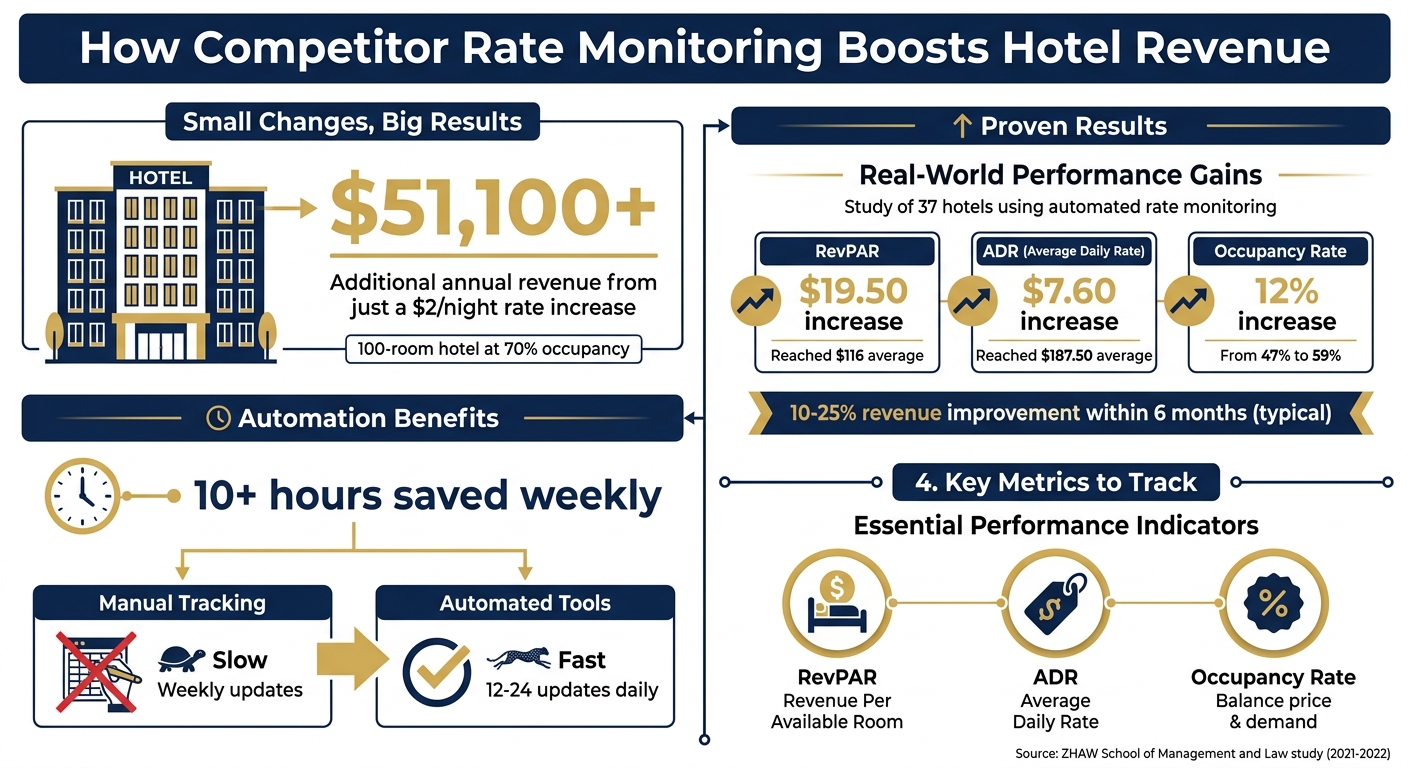
Maximize Revenue: Even a $2 increase in nightly rates can add over $50,000 annually for a 100-room hotel.
Automation Benefits: Save 10+ hours weekly by automating rate tracking, reducing errors, and focusing on guest experience.
Key Metrics to Watch: RevPAR, ADR, and Occupancy Rate to measure performance and adjust strategies.
What is Competitor Rate Monitoring?
Definition and Purpose
Competitor rate monitoring, often called rate shopping, is the process of using automated tools to track rival hotels’ rates across online travel agencies (OTAs) and direct booking channels. This provides a real-time snapshot of your pricing position in the market. Essentially, it’s about staying informed on how your rates compare to competitors.
But it’s not just about comparing prices. Competitor rate monitoring also acts as a gauge for market demand. For example, if your competitors increase their rates, it often signals higher demand in the area, giving you the opportunity to adjust your prices accordingly. Many hotels create a “comp set” of 5–10 competitors based on factors like location, star rating, amenities, and target audience. This comp set helps them benchmark their pricing and assess their competitive edge. If competitors are fully booked or charging higher rates for certain dates, it might be a good time to increase your rates or reduce discounts.
Metrics to Track
While tracking nightly room rates is essential, effective monitoring goes deeper. It includes keeping an eye on promotions, special packages, and pricing trends throughout the week. Ensuring rate parity across OTAs and direct booking channels is also critical to avoid “rate leaks” and inconsistencies.
Here’s an example of how small adjustments can make a big impact: In a 100-room hotel operating at 70% occupancy, increasing the nightly rate by just $2 could generate over $50,000 in additional annual revenue [2]. However, manually keeping up with these insights is slow and prone to mistakes, making automation a necessity.
Why Manual Tracking Doesn't Work
Manual rate tracking is time-consuming – taking over 10 hours each week – and diverts attention from revenue-driving activities [2]. It’s also less accurate and far less frequent than automated methods. Many hotels rely on spreadsheets to update rates weekly or even less often, while automated tools can refresh pricing data 12–24 times a day [2].
Managing rates manually across multiple OTAs, room types, and date ranges increases the likelihood of errors. As Cameron Gough, Chief Product Officer at RMS, explains:
“Accommodation providers today don’t just need access to data, they need the ability to act on it quickly and efficiently” [3].
The challenge becomes even bigger as your business grows. Tracking rates for one property is already tough – doing it across multiple locations or room types without automation makes it nearly impossible to keep up with market changes.
How Competitor Rate Monitoring Increases Revenue
Adjusting Prices Based on Market Data
Using real-time insights to guide your hotel pricing strategies allows you to base decisions on market trends rather than just a handful of competitors. This broader perspective helps attract travelers with different price sensitivities. A key metric to watch is “Market Factors”, which reflects the average percentage by which your competitors have adjusted their rates. For example, if competitors are raising prices, it often signals a surge in demand – an ideal time to consider increasing your rates. With today’s market featuring a mix of options like short-term rentals, branded hotels, and even properties in nearby neighborhoods, benchmarking against a diverse set of 10 properties gives you a clearer picture of demand shifts [1].
This approach helps you make pricing adjustments that align naturally with your hotel’s occupancy levels.
Balancing Occupancy and Profit
Competitor rate data becomes even more valuable when paired with your hotel’s occupancy metrics. If your competitors are fully booked and you still have availability, it might be time to raise your rates. On the flip side, if overall market occupancy is low, offering budget-friendly packages can keep your property competitive. This balance ensures you maximize revenue during peak demand while staying attractive during slower periods. To avoid over- or underpricing, set price floors and ceilings for each room type. This keeps automated pricing adjustments within profitable and brand-aligned limits [1].
Finding Opportunities for Promotions
Competitor monitoring isn’t just about pricing – it’s also a way to identify opportunities for promotions. By keeping an eye on competitor offers like bundled packages, perks, or flexible cancellation policies, you can craft deals that stand out. For example, you might adopt lead-time pricing, such as offering a 10% discount for bookings made four weeks in advance to secure base occupancy. Similarly, last-minute discounts can help fill rooms that remain unsold closer to the arrival date [1].
How to Implement Competitor Rate Monitoring
Choosing Your Competitor Set
Start by selecting a group of at least 10 competitors from OTAs. This group should include a mix of short-term rentals, branded hotels, and properties that influence market pricing. To identify the right competitors, focus on factors like location (close to attractions or business hubs), star rating, property type (boutique, hostel, etc.), room offerings and pricing, facilities (such as pools, spas, or restaurants), and target audience (leisure or corporate travelers). Don’t forget to include rate leaders – properties whose pricing tends to set the tone for the market. You can even assign weightings to each competitor based on how closely they align with your property. Since market conditions evolve, review and adjust this competitor set every quarter to ensure it stays relevant [1].
Using Automated Tools
Tools like RoomPriceGenie take the hassle out of competitor monitoring by continuously tracking key metrics like pricing, occupancy, and booking pace. You can customize settings for factors like price aggressiveness, target occupancy levels, and room-specific limits. The tool offers two modes: Auto-Pilot, which updates your PMS up to 24 times daily, and Co-Pilot, which lets you review and approve suggested price changes before they go live. It also integrates seamlessly with your PMS and Channel Manager, ensuring consistent pricing across all OTAs.
The results speak for themselves. A study involving 567 hotels using RoomPriceGenie showed impressive outcomes: RevPAR increased by over $19.50, reaching an average of $116, while Average Daily Rate climbed by about $7.60 to approximately $187.50. Additionally, room occupancy improved from 47% to 59% [4]. Once your tool is set up, configure alerts to respond quickly to market changes.
Setting Up Alerts and Tracking Trends
Automated tools are just the beginning. To stay ahead, set up specific alerts for key pricing events. For instance, you can create alerts for situations like a competitor selling out or an OTA undercutting your direct rate by more than 5%. Spend 15–20 minutes each morning reviewing these alerts and your 7-day forecast to address any immediate concerns, such as rate parity violations.
When alerted to a competitor’s price drop, investigate the reason behind it – whether it’s a drop in demand or a reactive move – before deciding how to respond. On the flip side, if competitors are sold out or raising rates, this could indicate an opportunity to increase your own prices or adjust discounts. If you’re using Auto-Pilot mode, the system will automatically react to changes in competitor pricing, ensuring you capture revenue opportunities even during weekends or holidays when manual monitoring might be limited [2].
Measuring Results from Competitor Rate Monitoring
Performance Metrics to Track
To gauge how well your competitor rate monitoring strategy is working, focus on three main metrics: RevPAR (Revenue Per Available Room), ADR (Average Daily Rate), and Occupancy Rate. These metrics give you a full picture – RevPAR ties together pricing and occupancy, ADR shows if your pricing aligns with the market, and Occupancy Rate ensures you’re balancing price and demand effectively. The key is to track these metrics over time to assess progress, not just current performance.
Another critical metric is the RevPAR Index, which measures your performance relative to competitors. Additionally, set up alerts for rate parity violations, such as when OTA prices dip more than 5% below your direct rates. Monitoring your booking pace – how quickly reservations are coming in compared to competitors – can also help you adjust pricing in real time to avoid losing revenue opportunities or overselling inventory [2].
Comparing Before and After Results
Once you’ve identified the metrics to watch, the next step is comparing results before and after implementing your strategy. Start by establishing a baseline for metrics like RevPAR, ADR, Occupancy Rate, and the time spent manually adjusting prices. Most hotels using automated monitoring tools report noticeable improvements within six months, with revenue gains typically ranging from 10–25% [5].
Regular reviews, such as quarterly check-ins, can help you understand how market changes are impacting your results. For example, a 100-room hotel operating at 70% occupancy that improves pricing by just $2 per room night could generate an additional $51,100 annually [2]. Comparing your performance against industry benchmarks can also ensure you’re staying competitive.
Case Study: Revenue Growth with RoomPriceGenie
A real-world example highlights the potential of automated competitor rate monitoring. Between 2021 and 2022, the ZHAW School of Management and Law studied 37 hotels that adopted RoomPriceGenie’s pricing automation tool. Led by Prof. Dr. Steffen Müller, Dr. Nina Heim, and Vera Lenggenhager, the study demonstrated clear benefits across various hotel types.
The results were impressive. On average, participating hotels saw their RevPAR increase by $18, climbing to approximately $107. ADR rose by $7, reaching around $173, while occupancy jumped from 47% to 59% – a 12 percentage point improvement. Importantly, these gains didn’t negatively impact guest satisfaction. Net Promoter Scores remained steady, and guests continued to view pricing as fair [4].
“It is encouraging to see that the participating hotels were able to improve their pricing competencies and that guest satisfaction does not decrease after introducing dynamic pricing.” – Prof. Dr. Steffen Müller, ZHAW School of Management and Law [4]
The study also highlighted operational efficiencies. Hotels saved about 10 hours per week on manual price monitoring, freeing up staff to focus on guest services and other revenue-generating activities [4].
How Hotels Strategically Scrape OTA Listings for Competitive Insights ?
Conclusion
Competitor rate monitoring has reshaped how hotels approach pricing, taking the guesswork out of setting rates. By keeping an eye on what nearby properties charge and adjusting your prices in real-time, you can strike the perfect balance between occupancy and profitability. This means raising rates when demand surges and lowering them during slower periods to fill rooms. It’s a smart way to avoid losing revenue due to outdated pricing strategies while capturing high-value bookings at the right time.
Hotels that adopt automated competitor tracking often report RevPAR improvements of 10–25% within just six months. These results come from better occupancy rates and higher ADRs. The secret? Moving away from manual spreadsheets and embracing tools that can update pricing up to 24 times a day. These systems factor in live competitor data, demand trends, and your property’s specific needs. For hotels with smaller revenue teams, this kind of automation is a game-changer.
RoomPriceGenie offers a solution that does it all – monitoring competitors, analyzing demand, and optimizing rates – all while integrating directly with your PMS or Channel Manager. This hands-off approach not only boosts revenue but also frees up your team to focus on delivering exceptional guest experiences.
“As the hospitality industry becomes increasingly competitive, embracing innovative automated pricing solutions will be an operational imperative for hotels of all types and sizes in achieving long-term financial success.” – Ari Andricopoulos, CEO, RoomPriceGenie [4]
FAQs
How do I pick the right competitor set for my hotel?
When selecting competitors, consider factors like location, size, target market, and quality level. Look for properties that offer similar amenities, have comparable star ratings, and deliver similar guest experiences. Dive into their pricing strategies, occupancy rates, and guest reviews to ensure they align with your market and audience.
By carefully choosing your competition, you can benchmark more effectively, fine-tune your pricing strategies, and make smarter decisions to maximize revenue.
How do I avoid a price war when competitors drop rates?
To steer clear of a price war, lean on competitor insights and smart pricing strategies. Tools like RoomPriceGenie can be a game-changer, as they track competitor rates and demand trends in real time. This allows you to make informed rate adjustments rather than rushing into reactionary price cuts.
Instead of slashing prices, focus on what sets your offerings apart – whether it’s standout amenities, exclusive promotions, or tailored packages. Align your pricing with seasonal demand and regional patterns to stay competitive. By taking this calculated, data-driven approach, you can protect your bottom line without resorting to unnecessary discounts.
What data should I connect to pricing automation to improve results?
To make pricing automation more effective, link essential data sources like competitor pricing, occupancy rates, and promotional campaigns. Combine this with internal data, such as booking trends and demand patterns, to predict spikes in activity. Keeping an eye on local events and seasonal trends can further fine-tune your approach, allowing for real-time price adjustments. By integrating these insights, you can stay competitive, boost revenue, and optimize occupancy rates.