
The hotel business runs on teamwork. When staff across departments work closely together and share information, it can lead to higher guest satisfaction, more engaged employees, and better hotel performance.
The same is true of hotel technology.
Standalone systems can be excellent at performing individual tasks, but the real magic happens when systems are connected across the hotel. Data flows automatically, decisions happen faster, and staff have more time to focus on guests.
It’s no surprise, then, that 78% of hoteliers cite integrations as critical when evaluating new technology, according to our recent global survey.
Connectivity is especially important in hotel revenue management, where the ability to maximize revenue depends on the free flow of data across three core systems: the property management system (PMS), channel manager, and revenue management system (RMS).
Let’s look at how connectivity supports the core functions of revenue management.
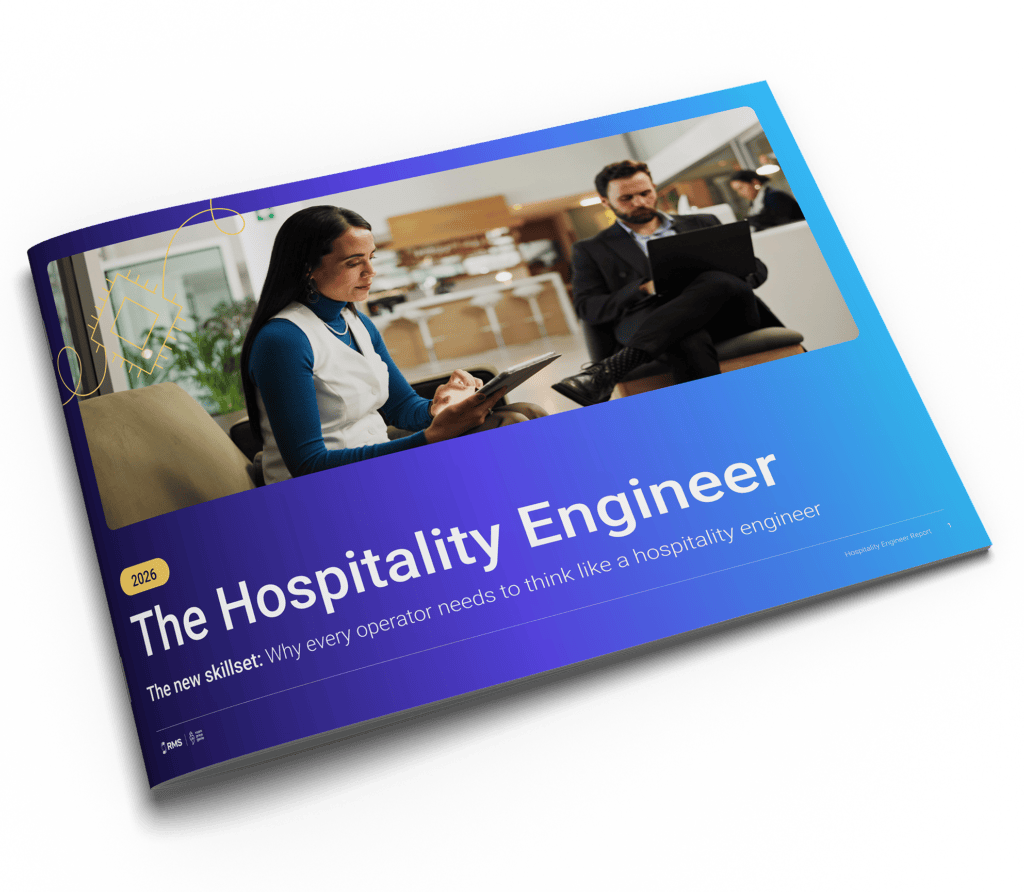
RoomPriceGenie × RMS “The Hospitality Engineer” Report: The new operator mindset every hotelier needs to know. Read the report.
Forecasting: Combining Data to Make Better Predictions
Forecasts are the foundation of revenue management, but they’re only as good as the data behind them.
When the PMS and RMS are fully connected, they continuously exchange information about rooms on the books, booking pace, average daily rate (ADR), cancellations, and historical trends.
Instead of staff having to manually export data and reconcile reports, the RMS automatically receives fresh data from the PMS in real time. This information helps hotels:
- Build more accurate budgets and revenue forecasts
- Spot periods of unexpectedly high or low demand
- Adjust pricing strategies proactively
- Focus marketing efforts on need periods
- Plan staffing and operations more effectively
With better visibility into future demand, teams can make more confident, proactive decisions throughout the hotel.
Dynamic Pricing: Aligning Rates with Market Demand
Pricing is one of the most challenging aspects of revenue management.
Without the continuous exchange of data between the PMS and the RMS, revenue managers must rely on guesswork and manual processes to price rooms – just like the old days.
The PMS focuses on the past and present, providing the RMS with crucial data about reservations, occupancy, average rate, pick-up, and historical performance. In turn, the RMS is forward-looking, recommending pricing based on PMS data, as well as competitor pricing and broader market demand signals.
This constant sharing of information enables dynamic pricing – automatically adjusting rates in response to changing demand patterns.
For example, the RMS might recommend (or automatically implement, depending on user settings):
- Raising rates when there’s a sudden spike in demand
- Lowering rates on a shoulder night between two sold-out dates
- Increasing prices for the last remaining rooms on a busy weekend
- Applying different pricing strategies to different room categories
- Holding rates when booking pace indicates demand is likely to materialize later
The result? Faster, more confident pricing decisions that drive incremental revenue.
Availability Controls: Protecting Revenue Across Every Night
Integrated systems also help hotels make better use of another essential revenue management tool: availability controls.
By analyzing booking trends from the PMS and channel manager, the RMS can identify high-demand dates and restrict inventory to the highest-value bookings.
Availability controls may include:
- Minimum length of stay requirements
- Closed-to-arrival or closed-to-departure restrictions
- Room type restrictions or closures
- Overbooking limits
- Cancellation policies
These controls help maximize revenue across an entire stay pattern rather than focusing on a single high-demand night.
For example, if demand surges around a major event, the RMS may recommend a two-night minimum stay to protect revenue on surrounding dates. Or it could close out entry-level room types to encourage the sale of higher-category rooms.
Because these controls are synchronized across connected systems, hotels can react quickly to changing demand without manually updating restrictions in multiple places.
Distribution: Managing Rates and Availability Across Channels
Today’s travelers compare prices across OTAs, metasearch platforms, travel agencies, and direct booking channels.
Every channel needs accurate pricing and availability, and connectivity makes this possible.
When rates or inventory change in the PMS or RMS, the channel manager distributes updates automatically across all connected channels. Likewise, reservations flow back into the PMS in real time, ensuring inventory remains accurate everywhere rooms are sold.
This helps hotels:
- Maintain rate parity and inventory accuracy across channels
- Prevent double bookings and overselling errors
- Prioritize preferred booking channels
- Adjust distribution strategies based on demand patterns
- Reduce manual updates and administrative work
This connectivity also saves revenue managers from one of the most time-consuming and tedious tasks in hotel distribution: updating extranets.
Segmentation: Offering the Right Rates to the Right Travelers
Not all guests book for the same reasons. Some prioritize flexibility. Others want the lowest price. Some are traveling for business, while others are planning a family vacation.
That’s why hotels create different rate plans and pricing strategies to appeal to different market segments.
Connectivity across systems helps ensure that the right offers reach the right guests at the right time. When systems work together, hotels can:
- Analyze demand patterns by segment
- Target rate plans and promotions to specific traveler segments
- Open and close rate plans automatically
- Apply rate restrictions and booking conditions consistently across channels
- Track the performance of different rate plans and segments
The result is more targeted selling and better alignment between pricing strategy and guest behavior.
Teamwork & Connectivity: A Powerful Combination
Just like great teams, great hotel technology performs best when the tech stack is connected, in sync, and speaking the same language.
When teamwork and connectivity come together, hotels can spend less time managing systems and more time maximizing performance.
Revenue Intelligence: The Next Evolution of Hotel Connectivity
With RoomPriceGenie’s Revenue Intelligence, key revenue insights are displayed directly within the PMS, giving staff the information they need to make informed decisions and maximize revenue without switching between systems. Find out more.
To learn how RoomPriceGenie can help your property boost hotel sales and increase your property’s profitability, start your free trial of our automated pricing solution today!