



If I had to boil it down to one rule, it’s this: use shared inventory for day-to-day transient demand, and use fixed allocation only for committed group or contract business.
That choice affects rate speed, oversell exposure, missed room revenue, and how well a multi-property portfolio handles demand changes. Shared inventory keeps rooms in one live pool, so availability and rates can update across channels in about 30 seconds to 2 minutes. Fixed allocation holds rooms for a partner or group, which gives room-count certainty but can leave unsold rooms stuck in blocks if pickup is weak.
Here’s the short version:
- Shared inventory fits properties with similar demand, such as city or airport clusters
- Fixed allocation fits weddings, conferences, tour series, and contract accounts
- Shared inventory risk: sync delays can lead to overbooking and double-sell issues
- Fixed allocation risk: blocked rooms may sit idle and push transient pricing too high
- Best setup for many portfolios: one live pool for transient business, plus fixed room blocks for committed demand
- Key rule: one system must control rates and availability, and canceled group rooms should go back into sale at once
Quick Comparison
| Factor | Shared Inventory | Fixed Allocation |
|---|---|---|
| How rooms are sold | One live pool across properties and channels | Set room counts held for a group, partner, or contract |
| Best use | Transient demand | Group and contract demand |
| Response to demand changes | Fast | Slower |
| Main risk | Oversells from sync lag or manual edits | Missed revenue from unsold blocked rooms |
| Pricing impact | Needs auto-updates to keep pace through real-time pricing optimization | Can distort transient pricing if blocks are treated as sold |
| Best portfolio fit | City clusters with similar demand | Mixed portfolios with group-heavy business |
Shared Inventory: Faster Response, But Only with Clean System Control
When demand moves fast, shared inventory helps a portfolio react in minutes instead of hours. One central rate or restriction update can flow to every connected property and channel at the same time. But that kind of speed only works when one system controls availability and rates.
Where Shared Inventory Gives Better Control Across Properties
Shared inventory tends to work best in city-center clusters where several properties serve similar guests and compete for the same demand. Think three select-service hotels within walking distance of a convention center in Las Vegas, or an airport cluster near Dallas–Fort Worth.
In setups like that, a central revenue team can set base rate structures, minimum length-of-stay rules, and markup ladders once across the full pool. That helps stop sister properties from undercutting each other for the same stay dates.
At the same time, local overrides keep the model grounded in day-to-day reality. A boutique hotel in the cluster may want to charge a small premium for suites or keep a local partnership rate in place. It can do that without breaking the pooled-inventory setup. Central rules with local flexibility is what makes pooled availability work across a portfolio, especially when the properties draw from the same demand base.
How Shared Inventory Affects Oversell Risk
Shared inventory doesn’t automatically lead to more oversells. What it does do is put more risk into one point of control, which means sync quality matters a lot more. In most cases, oversells come from delayed sync, duplicate sales paths, or manual edits made outside the source system.
The fix is pretty simple in theory: pick one system, usually the PMS or CRS, as the source of truth. Then connect every channel through the essential tech trio of two-way, real-time API sync. Modern PMS-channel manager setups usually sync in about 30 seconds to 2 minutes, which cuts down the window for double bookings by a lot.
Peak nights need a bit more caution. Holding back 2–5 rooms can reduce exposure from sync lag. Even then, fast inventory control still relies on automated rate updates.
When Pricing Automation Matters Most
Shared inventory also puts more pressure on pricing speed. If demand jumps across a pooled cluster, no team is going to keep up by manually changing rates across every property and every channel.
That’s where a tool like RoomPriceGenie comes in. It reads each property’s live booking pace and local demand signals, then pushes updated rates across connected channels automatically, as often as 24 times a day. For groups, it applies central pricing logic while still factoring in each property’s own performance.
The upside isn’t small. Hotels using RoomPriceGenie saw average results of +19% total revenue, +14% occupancy, and +4% ADR. Teams also saved about 10 hours per week on manual pricing work. That matters a lot when one shared inventory pool creates more rate decisions than a team can handle by hand.
Fixed Allocation: Clearer Guarantees, But Slower to Rebalance
If shared inventory leans toward speed, fixed allocation leans toward certainty. The trade is simple: rooms are held for a partner, group, or contract until release. In a multi-property setup, that block stays out of the shared pool until release, which stops one contract from eating into inventory across the portfolio. That setup is a good fit for long-term contracts, repeat business, and room-type commitments that need a set room count.
Where Fixed Allocation Gives Clearer Control
Fixed allocation makes sense for weddings, conferences, and corporate accounts that need a guaranteed count far ahead of arrival. It also helps when a group wants one flat rate across room types, so pricing stays consistent throughout the stay.
Revenue Risk: Unsold Rooms Trapped in Blocks
There’s a catch. Blocked rooms count as sold in revenue systems, so large group blocks can make transient rates climb too high unless group pickup is adjusted. The fix is pretty direct: update the group booking adjustment or the “room nights sold to groups” figure so the revenue system prices from actual transient demand. If a large group cancels, make that adjustment at once.
Group and Contract Scenarios Where Fixed Allocation Fits Best
This tradeoff can be worth it when the booking matters more than the option to resell every room day by day. Fixed allocation fits best when guaranteed availability matters more than pricing flexibility, especially for signed group blocks and contracted business that should not shift in real time.
For larger blocks, don’t price the request in a vacuum. Compare it against likely transient revenue before saying yes. Use displacement analysis to weigh the group rate against expected transient revenue before accepting the block.
Shared Inventory vs. Fixed Allocation: A Direct Comparison on Control, Pace, Risk, and Group Use
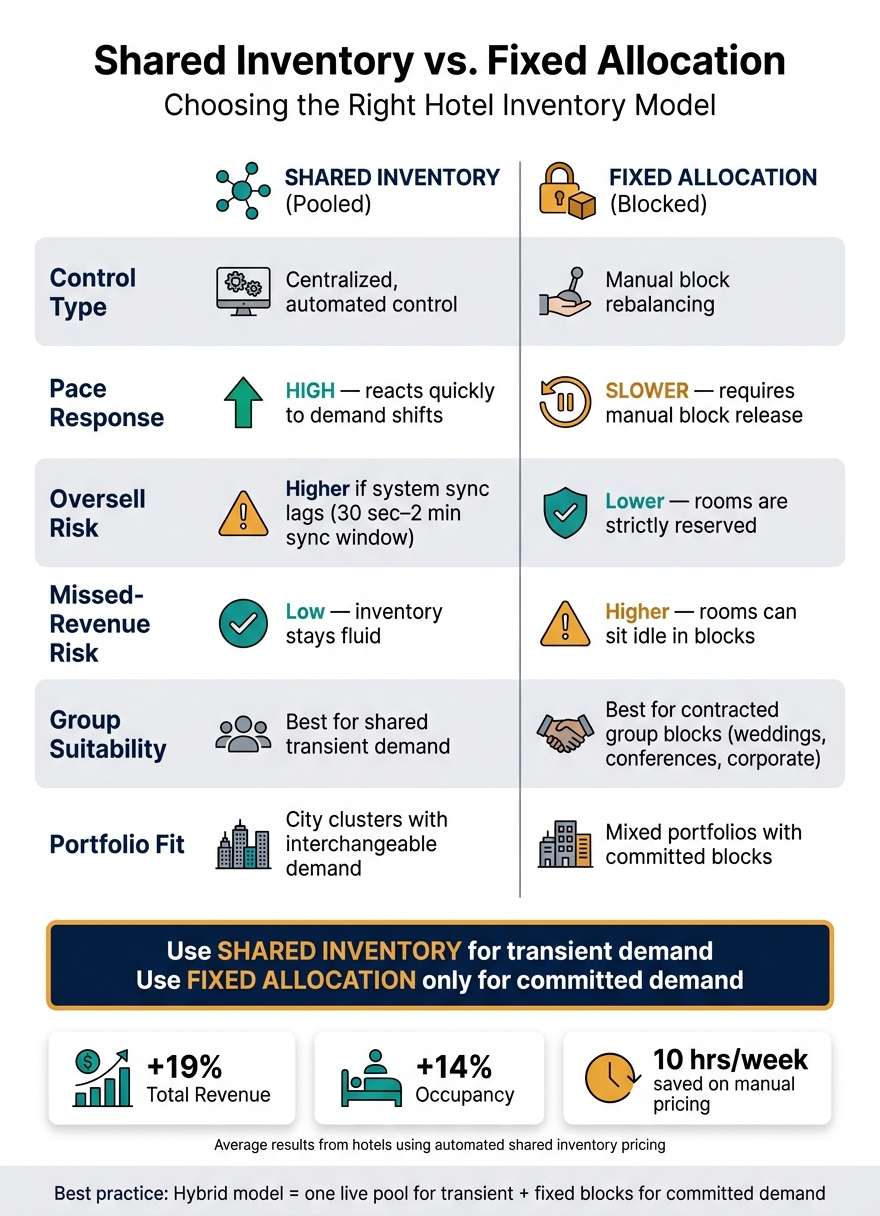
Both models can work. But they don’t work the same way, and that difference gets bigger as your portfolio expands. The right choice depends on how your properties sell day to day.
| Factor | Shared Inventory (Pooled) | Fixed Allocation (Blocked) |
|---|---|---|
| Control type | Centralized, automated control | Manual block rebalancing |
| Pace response | High – reacts quickly to demand shifts | Slower – requires manual block release |
| Oversell risk | Higher if system sync lags | Lower – rooms are strictly reserved |
| Missed-revenue risk | Low – inventory stays fluid | Higher – rooms can sit idle in blocks |
| Group suitability | Best for shared transient demand | Best for contracted group blocks |
| Portfolio fit | City clusters with interchangeable demand | Mixed portfolios with committed blocks |
Conclusion: Pick the Model That Matches How Your Portfolio Actually Sells
Once you stack up control, pace, risk, and group use, the choice is pretty simple: pick the model that fits the way the portfolio sells.
Shared inventory works best for fast-moving transient demand and centralized pricing. Fixed allocation makes more sense for contracted groups, corporate blocks, and tour deals that need guaranteed rooms.
A simple rule helps:
- Use shared inventory for transient demand
- Use fixed allocation only for committed demand
But there’s a catch. This only works if fixed blocks show up in the system right away. If fixed blocks exist, sync them in the revenue system so they aren’t read as transient demand. And if group rooms get canceled, release them at once.
When the inventory model lines up with how your properties sell, and your systems stay connected, pricing can react with better accuracy as demand shifts. This alignment is a key factor when you choose the right revenue management system for your portfolio.
FAQs
When should a hotel use a hybrid model?
A hotel group should use a hybrid model when sales and marketing teams operate at both the property and corporate levels.
It gives you a practical middle ground. The corporate office sets the strategy and goals, while property teams manage day-to-day revenue decisions and put local market knowledge to work. That setup helps keep the brand consistent across locations without tying the hands of on-site teams that know their guests, pace, and market conditions best.
What systems are needed for shared inventory to work well?
Shared inventory works best when your PMS, channel manager, and RMS are connected and updating each other in real time.
When that setup is in place, occupancy, booking pace, and historical data move automatically between systems. That gives you what you need for forecasting, pricing, and availability controls across channels, including minimum length of stay, room-type closures, and overbooking limits.
How often should fixed room blocks be reviewed or released?
Review fixed room blocks on a regular basis so your numbers stay right for pricing. There’s no set schedule. Still, periodic checks help keep your revenue management data in line with what’s actually happening.
If group bookings cancel or change, update those blocked rooms right away. If you don’t, the system may count them as sold. That can make demand look higher than it is and skew pricing recommendations.