

If your PMS data is late, your room rates are late too. I’d sum up the whole topic like this: dynamic pricing works best when your PMS, RMS, and channel manager share live data, sync both ways, and have clear rules for errors, limits, and approvals.
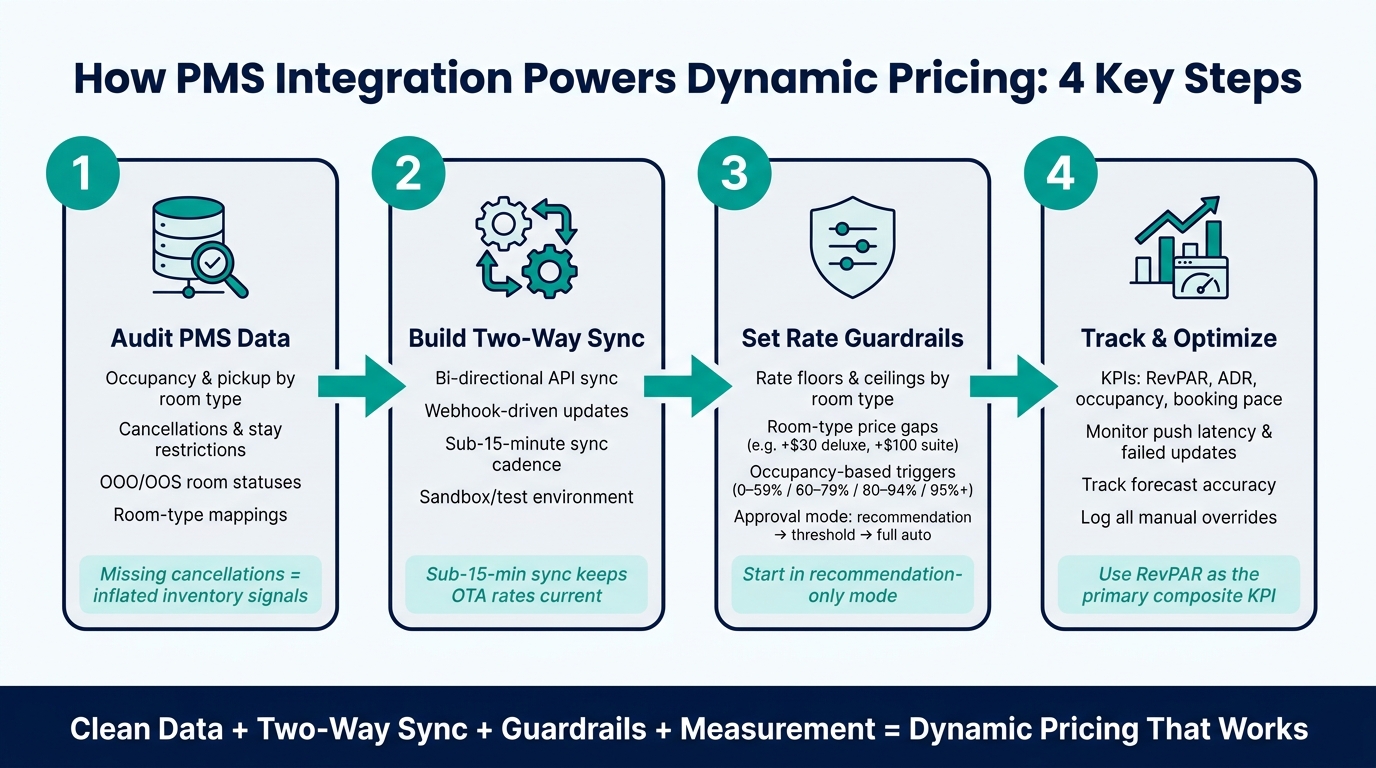
In plain terms, I’d focus on four things:
- Clean PMS data first: occupancy, pickup, cancellations, room types, taxes, fees, and room status all affect price decisions.
- Two-way system sync: rates need to move out, and booking changes need to move back in, without manual work.
- Rate guardrails: set floors, ceilings, room-type price gaps, and approval rules before auto-publishing.
- Track results after launch: compare RevPAR, ADR, occupancy, booking pace, cancellations, push latency, failed updates, and manual overrides against a pre-launch baseline.
A few details stand out. The article points to sub-15-minute sync timing, which matters because stale data can leave rates too high, too low, or missing on some channels. It also stresses that cancellations and room mapping errors are common failure points. And once automation starts, I’d watch RevPAR, forecast accuracy, and rate-delivery errors closely so pricing doesn’t drift.
En résumé : PMS integration improves dynamic pricing by giving the pricing system current booking and inventory data, sending updated rates back out fast, and cutting manual mistakes. But I wouldn’t trust automation without clean mappings, audit logs, test runs, and written override rules.
Audit Your PMS Data and Integration Setup Before You Automate
Dynamic pricing automation is only as good as the data and system links behind it. If the inputs are messy or the setup is shaky, the output will be too. That’s why you need to audit your PMS data, mappings, and integration paths before automation goes live. Start with what your PMS sends and how each system passes data back and forth. Then tie that clean data to the pricing workflow.
Check the Data Fields That Drive Pricing
Look closely at the fields that feed pricing decisions: occupancy and pickup by date and room type, cancellations, stay restrictions like MinLOS, CTA, and CTD, rate plans, taxes, and fees. If any of that data is missing, old, or mapped the wrong way, your pricing tool is making decisions on bad inputs.
Two issues tend to show up again and again.
- Missing cancellations can make inventory look fuller than it is, which keeps rates too high for rooms that are actually open [2][4]
- Mismatched room-type mapping can push rate updates to the wrong room category and cause rate mismatches across channels [2]
You should also review your Out-of-Order (OOO) and Out-of-Service (OOS) room statuses. If those statuses are wrong, the inventory signal gets distorted, and rate recommendations drift off course [2].
Verify the Integration Requirements
Not every integration works the same way. For example, a one-way connection – where data only moves from the channel manager to the PMS – means your RMS can’t push rates back on its own. That leaves your team stuck doing manual updates and increases overbooking risk [2]. You also need to confirm that the setup can move key fields both ways without human intervention.
| Integration Requirement | Why It Matters for Dynamic Pricing | What to Verify |
|---|---|---|
| Bi-Directional Sync | Ensures rates and availability flow both ways, reducing manual work and overbooking risk [2] | Confirm the RMS can push rates to the PMS and the PMS can push occupancy and reservation updates to the RMS |
| Webhook-Driven API | Pushes data the moment a reservation event occurs, enabling sub-15-minute updates [2] | Verify the system uses event-driven webhooks rather than scheduled polling |
| Sandbox/Testing Access | Protects live data while confirming the integration behaves as expected [2] | Run test bookings, modifications, and cancellations in a non-live environment |
| Audit Logging | Provides a forensic trail to diagnose why a rate failed to update or was published incorrectly [2] | Check that every rate push captures the user, timestamp, prior value, and new value |
One more setup detail matters here: modern API connections usually cut latency and mapping errors [2].
Assign Ownership for Mappings, Errors, and Overrides
This kind of setup works best when ownership is clear. Revenue Management should own pricing rules. Operations should own PMS accuracy. IT should own connection monitoring [2].
It also helps to define one system of record for each data type. In many cases, that’s the PMS for inventory, room types, and reservation status. When systems disagree, your team needs to know which one wins. And if someone has to make a manual override, route it through the RMS, not straight through the PMS or channel manager [2].
Once ownership is set, the pricing workflow can shift from setup mode to live updates.
Connect the PMS to Your Pricing Workflow
Use the audit findings to turn clean PMS data into pricing rules. But before you change any settings, get very clear on what you want the system to do. Your goal shapes everything: which signals matter, how much rates should move, and what guardrails need to stay in place.
Set Pricing Goals and Choose the Demand Signals
Tarification dynamique should respond to seasonality, weekday demand swings, holidays, and local events.
Once the goal is clear, choose the demand signals your pricing engine will use. These signal groups help guide that setup:
| Data Category | Specific Signals to Monitor | Purpose in Dynamic Pricing |
|---|---|---|
| Internal (PMS) | Occupancy, pickup, booking pace, length of stay | Shows when to push rates up because internal demand is strong, or bring them down during softer periods |
| External (Market) | Competitor rates, local events | Keeps your rates in line with what’s happening in the market |
| Operational | Out-of-order rooms, group block wash | Helps avoid overselling and improves forecasting |
| Restrictions | MLOS, CTA, CTD | Protects high-value dates by requiring longer stays or limiting arrivals; drive these with signals to get more revenue across stay patterns, not just single nights [1][2] |
Configure Mappings, Rules, and Update Frequency
With goals and signals in place, map your room categories and rate plans – non-refundable, breakfast-included, and the rest – between the PMS and the pricing tool. That way, every rate update lands where it should [2].
Aim for a sub-15-minute sync cadence between the RMS, PMS, and channel manager. That window is short enough to push new rates to OTAs before demand changes [2]. RoomPriceGenie connects to your PMS or channel manager and automates rate updates using live booking data, demand patterns, event signals, and competitor tracking.
Test the Full Rate Update Path Before Going Live
Before launch, test the full rate path in a sandbox so live rates stay untouched.
- Confirm PMS data reaches the pricing tool – Check that occupancy, pickup, and reservation events arrive correctly and on time.
- Confirm recommendations match the right room type and date – Make sure a rate suggestion doesn’t land on the wrong room type or the wrong date.
- Confirm updated rates return to the PMS and publish correctly across channels – Verify that the right value, room type, and rate plan appear in the PMS, and that OTAs and the direct booking engine show the same rate and any stay restrictions.
Test cancellations and booking changes on their own too. Those are often where lag and mapping issues show up [2].
Once the full rate path works end to end, add floors, ceilings, and approval rules before going live.
Set Pricing Guardrails and Approval Controls
Once the rate update flow is working, put guardrails in place before you automate publishing. PMS integration makes price changes much faster. That’s the upside. The catch is simple: speed without limits can push rates too low or too high. Guardrails set clear boundaries for what can go live on its own and what needs a person to step in.
Define Floors, Ceilings, and Occupancy-Based Rules
Start with a rate floor based on total sell cost: labor, distribution fees, amenities, and brand positioning. Then set a ceiling based on what the market will bear for that room type on that date. Set these limits by room type, not with one property-wide range. For example, a standard room might have a floor of $149.00 and a ceiling of $349.00, while a suite would sit higher at both ends [9][11].
Occupancy should act as the main trigger, with booking pace shaping the final move. A practical starting point for a standard room looks like this [5][9]:
| Occupancy Level | Pricing Action |
|---|---|
| 0%–59% occupied | Hold base rate or apply a controlled soft-period discount |
| 60%–79% occupied | Increase rate modestly as demand builds |
| 80%–94% occupied | Raise rate more sharply; remaining inventory is limited |
| 95% or higher | Apply the highest approved pricing band |
You’ll also want to protect price gaps between room types. If your standard room is $229.00, the deluxe room should stay at least $30.00 higher, and the suite should remain at least $100.00 higher [6]. Check those gaps at the floor, base rate, and ceiling. If you skip that step, rounding or separate recommendations can create an awkward mess where a better room ends up cheaper than a lower-category one.
For high-demand dates like major holidays, conventions, and local festivals, use a separate rule set. That usually means a higher base rate, fewer discounts, and règles relatives à la durée minimale de séjour when short stays would block stronger demand. Even then, the ceiling still applies. These date-specific rules should push rates closer to that upper limit and flag unusual jumps for review, not sidestep the cap on their own [5][6].
Those limits define the range. Approval controls decide what happens when a rate falls outside it.
Choose an Approval Mode and Set Override Procedures
After you’ve set rate limits, decide who can approve exceptions. The best setup depends on one thing more than anything else: how much you trust the data and how stable the integration is.
| Control Type | Objectif | Example Configuration | Risk if Omitted |
|---|---|---|---|
| Recommendation-only mode | Keeps a person in the publishing loop while you validate data and recommendations | System proposes $249.00; revenue manager approves before it goes live | Slower response and inconsistent manual pricing |
| Threshold-based approval | Automates routine changes; escalates exceptions | Auto-publish within $149.00–$349.00; require review for any change above 10% in 24 hours | Outlier rates may publish unchecked |
| Full automation | Maximizes speed and consistency for tested, trusted workflows | Update rates within floors, ceilings, room-type differentials, and event-date exceptions | Mapping errors or bad demand signals can affect many dates and channels quickly |
A good way to roll this out is to start with recommendation-only mode during a pilot or while PMS data is still being checked. Once mappings are clean and rate behavior looks steady, move to threshold-based approval. Full automation should come later, after you’ve confirmed the integration works from end to end and someone is watching performance on a steady basis.
Before launch, write down your override process. Be specific about who can make an override, why they can do it, which dates and room types it covers, and when it ends. Log every override and review it later so a short-term fix doesn’t quietly turn into a standing rule [10][2].
Pour multi-property groups, tighten controls even more. Corporate approval should be required for changes above 10%, rates that cross a brand rate band, or any update tied to contracted accounts or a major event date [7].
Measure Results and Refine the Integration
Once the integration is live, the job changes. Setup is done. Now it’s about measurement.
Track a Baseline and Monitor Live Performance
Before automation starts, record at least four weeks of historical data from the same season or booking window. You want an apples-to-apples comparison, not a random snapshot. Track occupancy, ADR, RevPAR, booking pace at 30, 14, and 7 days, cancellations, and the hours spent on manual pricing. Use RevPAR as the main composite KPI [14].
Start small. Pick one low-risk room type or a limited date range and run the system in recommendation or approval mode. Compare the system’s pricing suggestions with your manual decisions. After that, turn on automatic publishing for selected dates while keeping current rate limits in place. Only expand when rates, inventory, and reservations are syncing the way they should.
Your live dashboard should stack current results against both the pre-launch baseline and a similar prior period. Review pickup and booking pace every day. Check occupancy and rate performance at least once a week. Watch cancellations by channel and room type too. It also helps to track the nuts and bolts of the connection:
- percentage of rate updates acknowledged successfully
- average push latency
- failed updates
- stale-data alerts
- manual overrides
Stick to the same arrival dates, segments, and room types over time. That makes it easier to tell whether pricing changed the result or demand simply moved on its own. Précision des prévisions deserves close attention too. When it starts slipping, that’s often an early warning sign of a data or setup issue before RevPAR shows the damage [16][17].
Use these numbers to spot sync problems before they start eating into revenue.
Troubleshoot Common Integration Problems
When performance drops or alerts jump, find the source first. Don’t change rates blindly and hope for the best.
Most post-launch problems come from rate delivery failures, stale data, mapping mistakes, or too many overrides. If live results weaken, trace the update path before touching pricing.
| Observed Issue | Likely Integration Cause | Recommended Check |
|---|---|---|
| Rate update not appearing on an OTA | Mapping error, expired connection, or channel-level rejection | Confirm room and rate-plan mapping, re-authenticate the connection, resend the affected scope, and verify the public rate on the OTA extranet [13][15] |
| Outdated occupancy or reservation data | Infrequent sync, failed API job, or time-zone mismatch | Compare the latest reservation timestamp and occupancy total in the PMS with what the pricing tool received; check update frequency, failed jobs, API credentials, and time-zone settings, then pause automatic repricing until the feed is current [13] |
| Wrong room or rate-plan mapping | PMS room type linked to the wrong OTA room or rate linked to the wrong parent rate | Cross-reference PMS, pricing tool, channel manager, and OTA mapping sheets using the same identifiers; correct the mapping at the source and resend the affected dates, then run a test search or booking [13] |
| Repeated overrides of the same rule | Demand signals, guardrails, or competitor inputs don’t reflect local market context | Log each override with date, rate, reason, and outcome; if the pattern repeats weekly, revise the rule instead of treating each case as isolated [3] |
If a rate fails to appear on a channel, document the PMS or pricing-system value, timestamp, affected room type, rate plan, date, occupancy, and any error message before you dig in. Those details save time. A mapping problem often means you need a full availability or rate push, then a test booking to make sure the fix worked [13][15].
If the issue is stale data, don’t let old occupancy figures drive automatic repricing. Move the system back to approval mode until the mismatch is fixed.
Conclusion: What Better PMS Integration Actually Improves
PMS integration helps dynamic pricing work from better, faster inputs. When occupancy, reservations, and room availability move across systems without delay, pricing can react to live demand instead of old snapshots. Two-way sync also cuts duplicate entry and manual publishing mistakes.
A platform like RoomPriceGenie can support real-time pricing optimization, competitor tracking, demand analysis, and direct PMS or channel-manager connectivity. But the property still has work to do. It needs to check its data, review exceptions, and measure results against a baseline. Integration only improves pricing when data is clean, mappings are right, and guardrails remain in place. Automation adds speed. The team makes sure the output stays accurate.
questions fréquentes
How do I know if my PMS data is clean enough for dynamic pricing?
Check that your data mapping is accurate and consistent across your PMS, revenue management system, and channel manager. Room type codes, rate plan IDs, restriction definitions, and tax structures should match exactly.
You’ll also want to make sure your PMS is collecting and sending the right data, including occupancy, booking pace, and remaining inventory. On top of that, confirm that bi-directional sync is working as expected and that audit logs show no errors.
What sync speed is fast enough for reliable rate updates?
For dependable rate updates, aim for a refresh cadence of 15 minutes or less. If your polling schedule runs longer than that, delays can creep in. Event-driven updates help avoid that by sending changes right when they happen.
When you review your setup, put two-way API connections ahead of older XML or iCal methods. That’s the best way to support this sub-15-minute target and keep rates in sync across channels.
When should I use approvals instead of full automation?
Use approvals instead of full automation when you want direct oversight of your pricing strategy before rates go live.
This mode lets you review and approve rate changes by hand, so you keep extra control while still using data-driven insights from your revenue management system.