The hospitality industry in 2026 is being reshaped by automation and real-time data-driven strategies. Independent and boutique properties are leveraging AI-powered revenue management tools to stay competitive. Key trends include:
Real-Time Pricing: Automated systems adjust rates instantly based on booking patterns, local events, and competitor pricing.
Operational Efficiency: Automation reduces manual tasks, enabling staff to focus on guest experience.
Blended Travel: The rise of work-leisure trips creates new opportunities for tailored packages.
Direct Bookings Growth: Guests prefer personalized experiences and clear pricing, pushing properties to enhance their own booking platforms.
Total Revenue Focus: Metrics like TRevPAR emphasize overall profitability, including non-room revenue.
For small teams, tools like RoomPriceGenie simplify pricing decisions by analyzing market data and providing actionable recommendations. These platforms are accessible and effective for properties without dedicated revenue managers. By adopting automation, hoteliers can improve profitability while focusing on what matters most – delivering exceptional guest experiences.
Major Forces Affecting Hospitality in 2026
The hospitality industry is undergoing a fast-paced transformation, driven by changing guest preferences, economic challenges, and advancing technology. For independent properties, understanding these shifts is crucial to staying competitive. These evolving dynamics are reshaping booking behaviors and operational strategies in significant ways.
Changes in How Travelers Book and Stay
Travel habits are shifting, with last-minute bookings becoming more common. This trend makes it harder for properties to predict demand and requires more flexible pricing strategies to keep up with sudden changes.
Another major shift is the rise of blended travel. Remote work has enabled travelers to combine business trips with leisure stays, breaking the traditional weekday–weekend travel patterns. Properties that adapt to these new habits can tap into fresh revenue streams by offering tailored packages and services.
Demand has also become increasingly unpredictable. Local events, weather conditions, and even viral social media trends can cause sudden spikes or drops in bookings. To stay ahead, properties need to monitor these factors closely and adjust pricing strategies in real time.
Additionally, more travelers are opting for direct bookings. They’re drawn to the personalized communication, loyalty perks, and clear pricing that direct channels offer. This trend is pushing properties to invest in their own booking platforms and marketing efforts to strengthen customer relationships and reduce reliance on third-party platforms.
In this fast-changing booking landscape, automation is becoming a key tool for staying competitive.
Why Properties Are Turning to Automation
Economic pressures and operational challenges are leading independent hoteliers to embrace automation. Labor shortages remain a significant hurdle, and smaller teams often don’t have the bandwidth to manually manage multiple booking channels. Automation eases this burden by streamlining processes and saving valuable time.
Rising operational costs – such as utilities, maintenance, and supplies – are also forcing properties to maximize revenue from every available room. Automated pricing tools can help fine-tune strategies to ensure no opportunity for income is missed.
The speed of market changes makes manual tracking nearly impossible. Monitoring competitor rates, booking trends, and local events all at once is a daunting task for any manager. Automation solves this by scaling operations efficiently, allowing consistent revenue management across multiple properties without requiring a dedicated team at each location.
Precision has become crucial for profitability. Automated systems analyze a wide range of factors simultaneously, ensuring rooms are priced optimally during both high-demand and slower periods. This level of accuracy is difficult to achieve with manual methods, making automation a game-changer for many properties.
Real-Time Data and AI Forecasting
Advancements in AI are revolutionizing forecasting by combining historical data with live market signals to adjust rates in real time. These systems are capable of processing diverse data sources – like local event calendars, weather forecasts, and industry trends – to provide a comprehensive market view.
Over time, AI-powered systems improve their algorithms, delivering increasingly accurate and effective pricing strategies. They also offer transparency by clearly showing the factors influencing pricing decisions, such as competitor rates and booking trends. This transparency builds trust with hoteliers, giving them confidence in the system while still maintaining control over pricing.
In this rapidly evolving environment, leveraging real-time data and AI-driven tools is becoming essential for staying ahead of the curve. Hoteliers who embrace these technologies can navigate market complexities with greater ease and precision.
Technology and Revenue Management Trends for 2026
The hospitality industry is evolving, with technology playing a central role in shaping revenue strategies. For independent properties, staying ahead of these changes is critical to remaining competitive. The latest advancements are driving more refined automated pricing tools and dynamic revenue approaches.
AI and Machine Learning in Revenue Management
Artificial intelligence (AI) and machine learning are changing the game when it comes to pricing and demand forecasting. These technologies analyze booking patterns to make smarter predictions.
AI-driven revenue management systems can process massive amounts of data – like competitor pricing, booking trends, and seasonal demand – to suggest the best rates for different room types. Over time, as they handle more bookings, these systems get better at identifying the most effective pricing strategies for specific scenarios. They also allow for channel-specific pricing, meaning rates can be adjusted based on where a booking comes from. Plus, their ability to respond in real time means properties can quickly adapt to market changes.
Total Revenue Management (TRevPAR)
Total Revenue Per Available Room (TRevPAR) takes a broader approach by focusing on overall profitability, not just room revenue. This includes revenue from additional services like dining, spa treatments, and other on-site offerings, giving properties a more comprehensive view of their financial performance.
Using Multiple Data Sources for Better Pricing
By 2026, effective pricing strategies will depend on pulling data from multiple sources. Properties that incorporate forward-looking demand indicators and broader economic trends will be better positioned to succeed.
Modern revenue management systems are designed to handle this complexity. They combine real-time data from a variety of sources and turn it into actionable pricing recommendations. This approach is especially useful in uncertain times, allowing properties to quickly adjust their strategies to match shifting market trends and guest behaviors.
These advancements are setting the stage for more precise and flexible revenue management strategies, helping properties navigate an ever-changing market landscape.
Automate Your Hotel’s Revenue Management
Maximize revenue, optimize occupancy, and save time with RoomPriceGenie’s intuitive automated pricing solution. Designed for independent hotels, groups, B&Bs and short-term rentals, our system ensures competitive, data-driven pricing with minimal effort.
Automated Pricing and Dynamic Strategies
As we dive deeper into technological advancements, automated pricing emerges as a game-changer in revenue management. By leveraging algorithms to analyze market trends and adjust rates in real time, properties – especially smaller ones without dedicated revenue teams – can now stay competitive with far less effort.
How Automated Pricing Algorithms Work
Automated pricing systems process a wide range of data points, such as historical booking trends, competitor rates, local events, seasonal patterns, booking speeds, and daily demand fluctuations. Using this information, they generate tailored rate recommendations designed to maximize revenue. These systems constantly monitor and update their analysis, ensuring that pricing strategies remain relevant as conditions evolve.
Key features include:
- Average Daily Rate (ADR) Recommendations: The system suggests optimal room rates in U.S. dollars for each room type.
- Length-of-Stay Adjustments: It adjusts pricing for short-term versus extended bookings.
- Channel-Specific Pricing: Ensures consistent pricing across distribution platforms to avoid discrepancies.
These systems rely on pattern recognition and predictive modeling to identify trends that influence occupancy and revenue. For example, rates might automatically increase during local events when demand surges.
Manual vs. Automated Revenue Management
The differences between manual pricing, rules-based systems, and AI-driven automation highlight just how transformative automated tools can be:
| Aspect | Manual Pricing | Rules-Based Systems | AI-Driven Automation |
|---|---|---|---|
| Update Rate | Sporadic updates | Regular updates using preset rules | Continuous, real-time adjustments |
| Data Processing | Limited manual analysis | Handles predefined scenarios | Processes numerous data points simultaneously |
| Response Time | Slow to react | Faster than manual methods | Near-instant adjustments |
| Labor Requirements | High manual effort | Moderate oversight | Minimal oversight needed |
| Accuracy | Prone to human error | Reliable within rule limits | Learns and improves over time |
| Revenue Impact | Basic performance | Moderate improvement | Maximizes revenue potential |
While rules-based systems automate some pricing tasks, they’re restricted by the scenarios they were designed for. AI-driven systems, however, adapt dynamically, identifying patterns and making adjustments based on real-world conditions.
Benefits of Dynamic Pricing for Independent Properties
Dynamic pricing is particularly advantageous for smaller properties, offering tools to compete effectively without adding operational burdens. Here’s how:
- Time Efficiency: Automated systems take over the heavy lifting of rate analysis, freeing up property managers to focus on guest satisfaction and property maintenance.
- Market Responsiveness: With real-time adjustments, properties can stay competitive as market conditions shift.
- Revenue Growth: By balancing occupancy and rate goals, these systems optimize revenue – whether through discounted rates during slow periods or premium pricing during peak demand.
- Rate Consistency: Automated updates across all channels help maintain consistent pricing, reducing the risk of conflicts or errors.
- Data-Driven Decisions: Removing human bias, the system relies solely on data, ensuring logical and strategic rate adjustments even during unpredictable demand swings.
For independent properties, dynamic pricing simplifies revenue management while delivering powerful results. By automating complex processes, these systems empower smaller operations to thrive in competitive markets.
How to Adopt Automation in Revenue Management
Making the shift to automated revenue management doesn’t have to be daunting, even for independent and boutique properties. By following a structured approach, you can streamline the process and start reaping the benefits of automation.
Review Your Current Pricing Strategy
Start by assessing your current pricing approach. How often do you adjust rates – daily, weekly, or only occasionally? How much time do you spend each week on pricing decisions? Take note of your data sources: Are you manually checking competitor prices? Relying on intuition to tweak rates for peak seasons? This self-assessment will highlight inefficiencies that automation can address.
Next, evaluate rate consistency across platforms like your booking engine, Expedia, and Booking.com. Discrepancies in rates can confuse potential guests or even violate rate parity agreements.
Dive into your performance metrics as well. Calculate your average daily rate (ADR) and occupancy for the past year. Pinpoint periods when rooms sold out well in advance – these might have been opportunities to raise rates. Similarly, identify times when rooms went unsold despite price drops, which could signal that adjustments came too late. This analysis gives you a clear starting point and helps set realistic goals for automation.
Setting Up an Automated Revenue Management System
Once you’ve reviewed your pricing strategy, it’s time to integrate an automated revenue management system. Most modern systems, like RoomPriceGenie, can connect directly to your property management system (PMS) or channel manager. This integration allows the system to access your inventory, rates, and booking data, eliminating the need for manual updates.
Begin by inputting essential details about your property, such as room types, base rates, and rate restrictions. Set floor prices to ensure rates never dip below a certain level and ceiling prices to cap rates during peak demand. These safeguards help maintain competitive yet profitable pricing.
Next, establish business rules to guide the system. For example, set occupancy targets based on your goals – whether it’s filling rooms during slower seasons or maximizing revenue during busy periods. You can also define minimum stay requirements for weekends or special events and adjust lead time settings to increase rates as demand rises closer to specific dates.
To fine-tune your strategy, identify three to five comparable properties that cater to a similar audience. The system will monitor their rates and use this data to refine its recommendations. Focus on competitors that align with your property in terms of size, amenities, and location.
Many properties start with a hybrid approach, where the system suggests rate changes but you retain final approval. This lets you build confidence in the system’s logic before transitioning to fully automated updates.
Tracking Performance and Measuring Results
Once your automated system is up and running, tracking its performance is essential to ensure it’s delivering results. Start by focusing on key metrics:
- Average Daily Rate (ADR): This shows whether the system is optimizing your pricing strategy. Compare ADR month-over-month and year-over-year to spot trends.
- Occupancy Rate: While 100% occupancy might seem ideal, it could indicate missed opportunities to charge higher rates.
- Revenue Per Available Room (RevPAR): This metric balances rate and volume, offering a clearer picture of overall performance.
- Total Revenue Per Available Room (TRevPAR): If you have additional revenue streams like dining or spa services, this metric captures the full revenue impact of your pricing strategy.
- Gross Operating Profit Per Available Room (GOPPAR): This goes a step further by factoring in operating costs, helping you gauge whether revenue growth is improving your bottom line.
Most automated systems provide dashboards with real-time metrics. During the early stages, review these weekly to identify patterns, such as underperforming room types or high-performing distribution channels. As you grow more comfortable, you can shift to bi-weekly reviews.
Pay attention to your booking pace as well. Strong early bookings suggest competitive pricing for planners, while last-minute bookings at higher rates indicate effective pricing during peak demand. A balanced mix shows your strategy is appealing to a variety of guest segments.
Don’t forget qualitative feedback. Are guests mentioning good value in reviews? Are direct bookings increasing because your rates are more competitive? These insights complement hard data and give a more complete picture of your revenue management success.
As your automated system gathers more data about your property’s booking patterns and market trends, its recommendations will become increasingly precise. Your role will shift from managing day-to-day pricing to overseeing strategy, ensuring the system aligns with your broader business goals while it handles the details.
Preparing for Hospitality in 2026
The hospitality industry is shifting fast. By 2026, properties that embrace automation will not only streamline operations but also boost revenue. For independent hoteliers, adapting to these changes is critical for staying competitive.
What Independent Hoteliers Should Remember
Automated pricing beats manual guesswork every time. Relying on spreadsheets and intuition is no longer enough. Manual pricing often leads to missed opportunities – underpricing during high demand or overpricing when business slows. Automated systems, on the other hand, analyze a wealth of data, including competitor rates, local events, booking trends, weather forecasts, and historical demand. These systems adjust prices in real time, ensuring you’re always capturing the best opportunities, even when you’re focused on running your property.
Think beyond room rates – focus on total revenue. Attracting guests with competitive room pricing can lead to higher spending across your property, whether it’s at the restaurant, spa, or through room upgrades. Prioritizing overall profitability instead of just room rates ensures you’re maximizing every revenue stream.
Ease into automation. You don’t have to transform your entire operation overnight. Start small by automating your pricing strategy while keeping a close eye on the system’s recommendations. Review and fine-tune weekly, gradually reducing manual adjustments as you gain confidence. Waiting too long to adopt these tools could leave your property struggling to catch up with competitors who’ve already optimized their processes.
Set boundaries to protect your margins and reputation. Establish clear floor and ceiling prices. Floor prices ensure you cover costs and maintain your brand image, while ceiling prices prevent rates from climbing so high they alienate guests. These safeguards let automation work within limits that align with your business goals.
To navigate these challenges effectively, independent hoteliers need tailored automation solutions that address their unique needs.
How RoomPriceGenie Helps in 2026
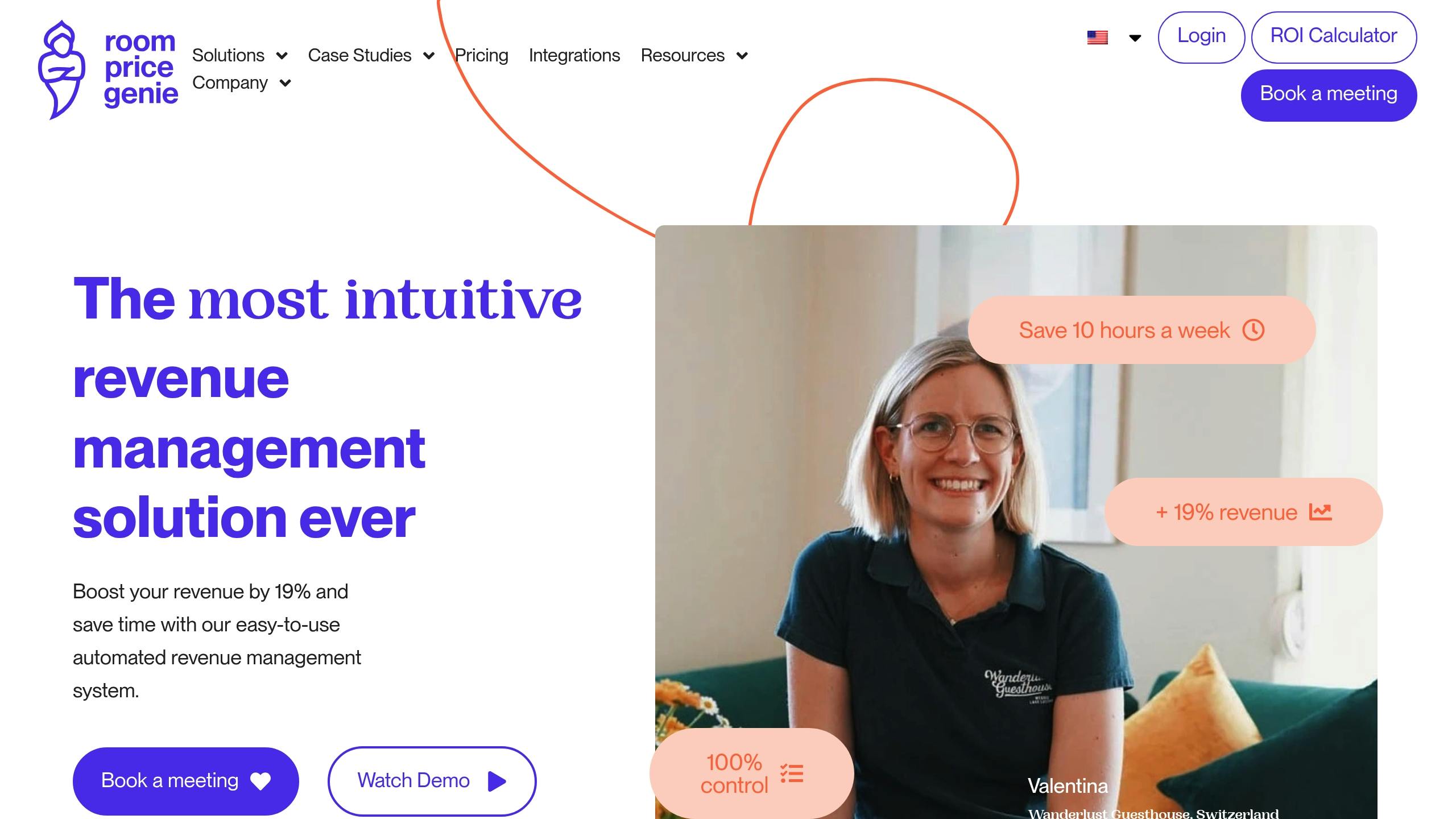
RoomPriceGenie is designed specifically for independent and boutique properties, tackling the challenges of a competitive market head-on. By integrating directly with your property management system or channel manager, it eliminates the need for manual data entry and ensures consistent rates across all booking platforms.
The platform monitors competitor pricing in real time and provides pricing recommendations that can adjust up to 24 times daily on the Professional plan. With 12 months of future pricing insights, you can plan for seasonal trends while staying agile enough to respond to sudden market changes.
Features like surge price protection prevent dramatic rate hikes, while bulk editing tools allow you to make quick adjustments across multiple dates or room types when needed. The system also supports revenue optimization with lead time settings that automatically increase rates as check-in dates approach and demand rises.
A user-friendly revenue performance dashboard gives you a clear view of automation’s impact. You can track critical metrics like ADR, occupancy, RevPAR, and TRevPAR, all in one place. For those on the Professional plan, scheduled reports deliver updates directly to your inbox, keeping you informed without extra effort.
For properties looking to take their strategies further, RoomPriceGenie offers segmentation tools that allow tailored pricing based on factors like guest type, booking channel, or stay length. Over time, the system learns your property’s booking patterns, refining its recommendations to align with your unique market position.
As 2026 nears, the real question isn’t whether you should automate – it’s how quickly you can implement tools that keep you competitive while freeing you to focus on what truly sets your property apart. With technology managing pricing complexities, you can dedicate your energy to delivering the outstanding guest experiences that drive positive reviews, repeat business, and long-term growth.
FAQs
How can independent hotels adopt automated pricing strategies without disrupting their current operations?
Independent hotels can make the most of automated pricing strategies by selecting tools that are easy to use and work well with their current systems. These tools offer real-time rate adjustments and use AI-powered pricing optimization to keep rates competitive without needing constant manual effort.
To keep things running smoothly, it’s smart to begin with automating a few specific pricing tasks. Once your team gets the hang of it, you can gradually expand the system’s use. This step-by-step approach helps you improve occupancy and boost revenue without disrupting daily operations.
What are the main advantages of using AI-powered revenue management systems for small boutique hotels?
AI-driven revenue management systems bring a host of advantages to small boutique hotels. For starters, they can cut down on manual work by as much as 50%, freeing up staff to concentrate on delivering exceptional guest experiences. On top of that, they enhance forecasting precision by over 20%, empowering hoteliers to make smarter pricing decisions and stay competitive in a constantly shifting market.
These systems use advanced algorithms to process real-time data, predict demand patterns, and automatically adjust room rates. The result? Higher occupancy rates and greater profitability, giving boutique hotels the tools they need to thrive in today’s fast-changing hospitality industry.
How is the growing trend of blended travel influencing hotel pricing and services?
Blended travel – where people mix business with leisure during a single trip – is changing the way hotels think about pricing and services. To keep up, hotels might want to introduce flexible pricing options that accommodate extended stays and cater to the varying needs of these travelers.
On top of that, hotels can stand out by offering a mix of business-friendly amenities like fast Wi-Fi and comfortable workspaces, alongside leisure perks such as spa treatments or personalized local experiences. Striking the right balance between work and relaxation can help hotels win over this growing group of travelers.
To learn how RoomPriceGenie can help your property increase your property’s profitability, start your free trial of our automated pricing solution today!