

Some hoteliers think that forecasting is only for big hotels and branded properties.
But forecasting is an important planning tool for every hotel, whether it’s a small boutique property, a large resort, or a small hotel group.
That doesn’t mean every hotel approaches forecasting in the same way. While the fundamentals of forecasting are the same, every property faces different challenges.
Let’s look at the key differences between forecasting for independent hotels and small groups.
Why Forecasting Matters for All Hotels
First, why is forecasting important for every hotel?
A forecast is a report that projects hotel occupancy, average rate, and revenue by day, by month, and for the year ahead. An accurate forecast provides:
- A clear picture of whether you’re on track to meet budget, with time to adjust if you’re not.
- Early warning on low-demand dates when you’ll need to stimulate bookings.
- Visibility into high-demand dates when you can raise rates or add restrictions to capture more revenue.
- Advance notice of business flows so operations can schedule staff and stock supplies to be prepared for rushes and better manage costs.
- A stronger foundation for longer-term planning, from setting sales targets to managing owner expectations.
Without an accurate forecast, hotels risk missing revenue opportunities, overspending on operations, and failing to meet the expectations of guests and owners alike.
Forecasting For Independent Hotels: Keeping a Step Ahead
When it comes to forecasting, independent hotels face a different set of realities than their branded counterparts:
- The need to be proactive. Without the benefit of chain recognition or loyalty programs, independents can’t afford to wait for bookings to roll in. They need to anticipate demand and take action early with pricing and marketing.
- Limited resources. Often the GM, owner, or another manager fills double duty as the revenue manager. Forecasting has to be quick and efficient to fit alongside all the other responsibilities.
- Smaller data sets. With fewer rooms and data sources, forecasts are simpler for small properties, but they may rely more heavily on intuition than hard numbers.
- Basic tools. Many independents still rely on spreadsheets or PMS reports to manage pricing and availability. Without a revenue management system (RMS), forecasts are done manually and infrequently (if at all).
The result? Forecasting for independent hotels is often inefficient and out of sync with real demand, leading to overpricing or underpricing and overstaffing or understaffing.
Forecasting for Hotel Groups: Balancing Consistency with Local Flexibility
Hotel groups generally have more resources and expertise in revenue management, but forecasting comes with its own challenges:
- More complexity. Hotel groups juggle multiple properties, often in different locations with distinct demand patterns. Aligning them is no easy task.
- Consistency vs. flexibility. Corporate oversight helps ensure consistent standards across properties, but each hotel still needs the freedom to respond to local market conditions. Striking that balance can be tricky.
- Bigger data sets. More data sources can improve accuracy, but it also means consolidating and reconciling numbers from a broader range of inputs.
- Technology differences. If each property uses its own software systems, it can be difficult to standardize reporting and compare performance across the group.
For groups, forecasting isn’t just about one property. It’s about the bigger picture. A strong forecast helps decide where to place groups, whether to shift business from one property to another, and how to align strategies across the portfolio. Errors at the group level can cascade, leading to poor planning decisions that affect multiple properties.
Automated Forecasting: A Smarter Solution for Every Hotel
Whether you operate a single property or a small group, forecasting takes time and effort – and it might involve more intuition and guesswork than it should. That’s why more hoteliers are turning to automated forecasting solutions.
- For independents: An RMS removes the manual burden, updating forecasts and pricing automatically so managers can focus on guests and strategy.
- For groups: Automation ensures consistency across properties and enables centralized forecasting while still allowing each hotel to reflect its unique market conditions.
In both cases, automation takes both the grunt work and guesswork out of forecasting, making it faster, easier, and more accurate.
While the tools and priorities may differ among hotels, the goal is the same: to anticipate demand, make data-driven decisions, and capture more revenue.
With the right approach and the right technology, forecasting becomes less of a chore and more of a roadmap to long-term success.
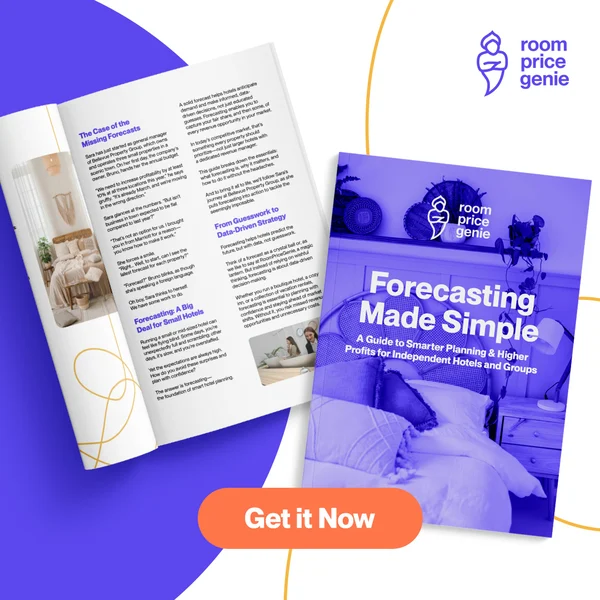
To learn more, download our new guide: Forecasting Made Simple: A Guide to Smarter Planning & Higher Profits for Independent Hotels and Small Groups.
To learn how RoomPriceGenie can help your property increase your property’s profitability, start your free trial of our automated pricing solution today!